


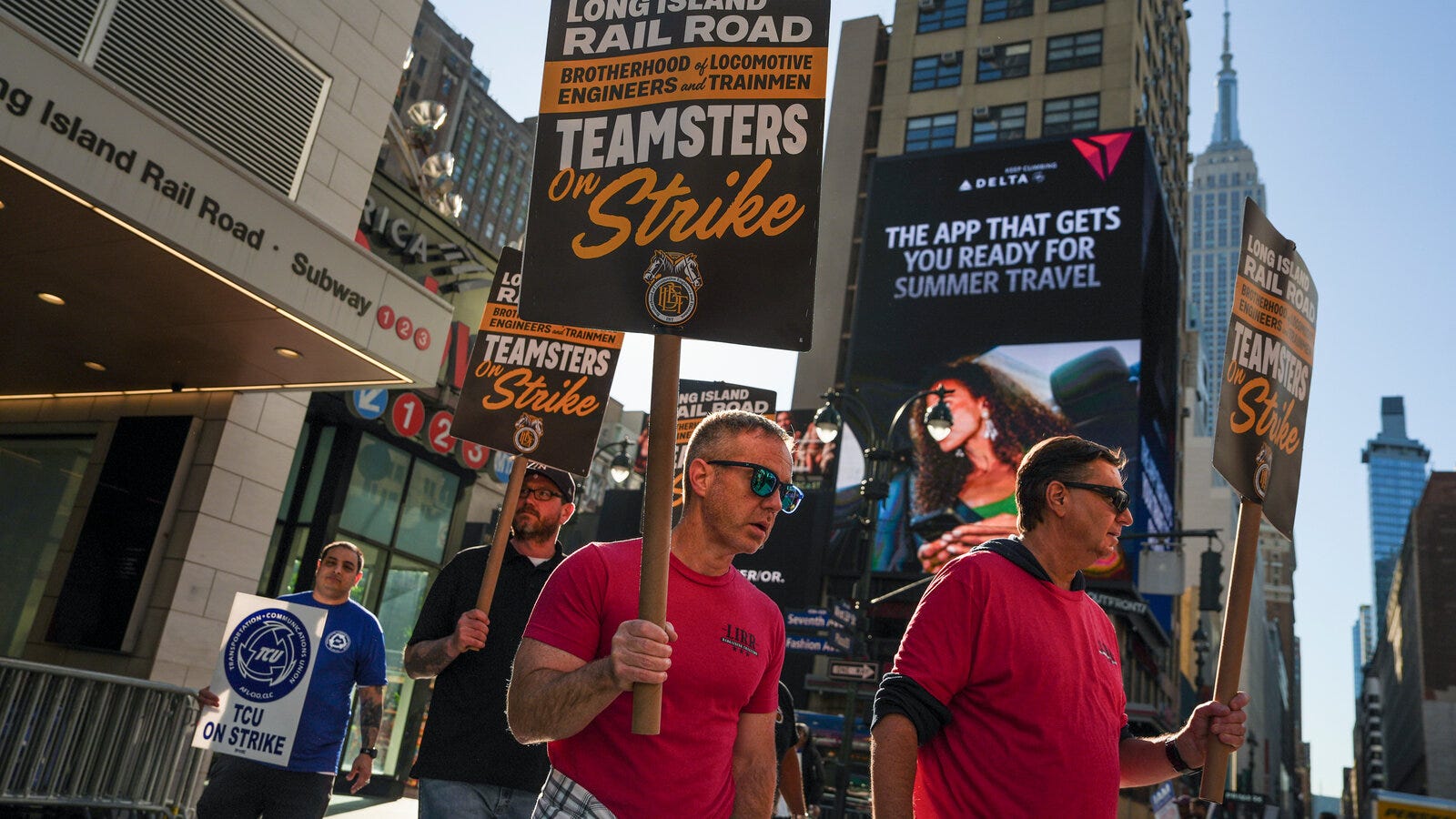
LIRR workers shut down nation’s busiest commuter rail line
At 12:01am Saturday morning, roughly 3,500 Long Island Rail Road workers walked off the job, shutting down the busiest commuter rail line in North America and disrupting travel for nearly 300,000 daily riders across the New York metro region. Workers represented by a coalition of five unions led by the Brotherhood of Locomotive Engineers and Trainmen (BLET-IBT) struck after three years of negotiations with the MTA. Workers have gone three years without raises while inflation and housing continued to rise across one of the most expensive metro regions in the country.
At the center of the fight is a simple demand: wages that actually keep up with the cost of surviving in New York. The MTA offered lump-sum bonuses for 2026 rather than permanent raises, while workers argued temporary payments do nothing to solve the long-term erosion of wages.
Railway and airline workers operate under the Railway Labor Act (RLA), a far more restrictive legal framework that puts brakes on efforts by workers to go out on strike. Passed in 1926 and expanded to airlines in 1936, the law was designed explicitly to contain disruptions in transportation by forcing workers through endless mediation, cooling-off periods, presidential emergency boards, and even federal intervention before workers can legally strike.
This strike itself was originally expected in September 2025, but repeated interventions delayed it for months. Many workers still remember the federal government’s intervention to stop the national rail strike in 2022, when Congress and President Biden blocked 115,000 rail workers from striking after years of brutal scheduling and unsafe working conditions. Workers were told the economy was too dependent on them to allow a shutdown.
Transit and rail workers – along with airlines and other logistics workers – have enormous power because the economy depends on them. When trains stop, cities stop. Congested streets hold the city in gridlock. Finance, logistics, and daily life slow down. The entire structure of the economy reveals how dependent it is on workers who are usually treated as invisible.
The LIRR last struck in 1994, shutting the system down until Congress intervened. Before that came major strikes in 1987 and 1960. Even under one of the harshest labor laws in the country, rail workers have repeatedly found ways to exercise their leverage. This strike is a reminder that even when the law is built to contain worker power, there are moments when workers in critical infrastructure can still force the issue – and bring entire regions to a standstill.
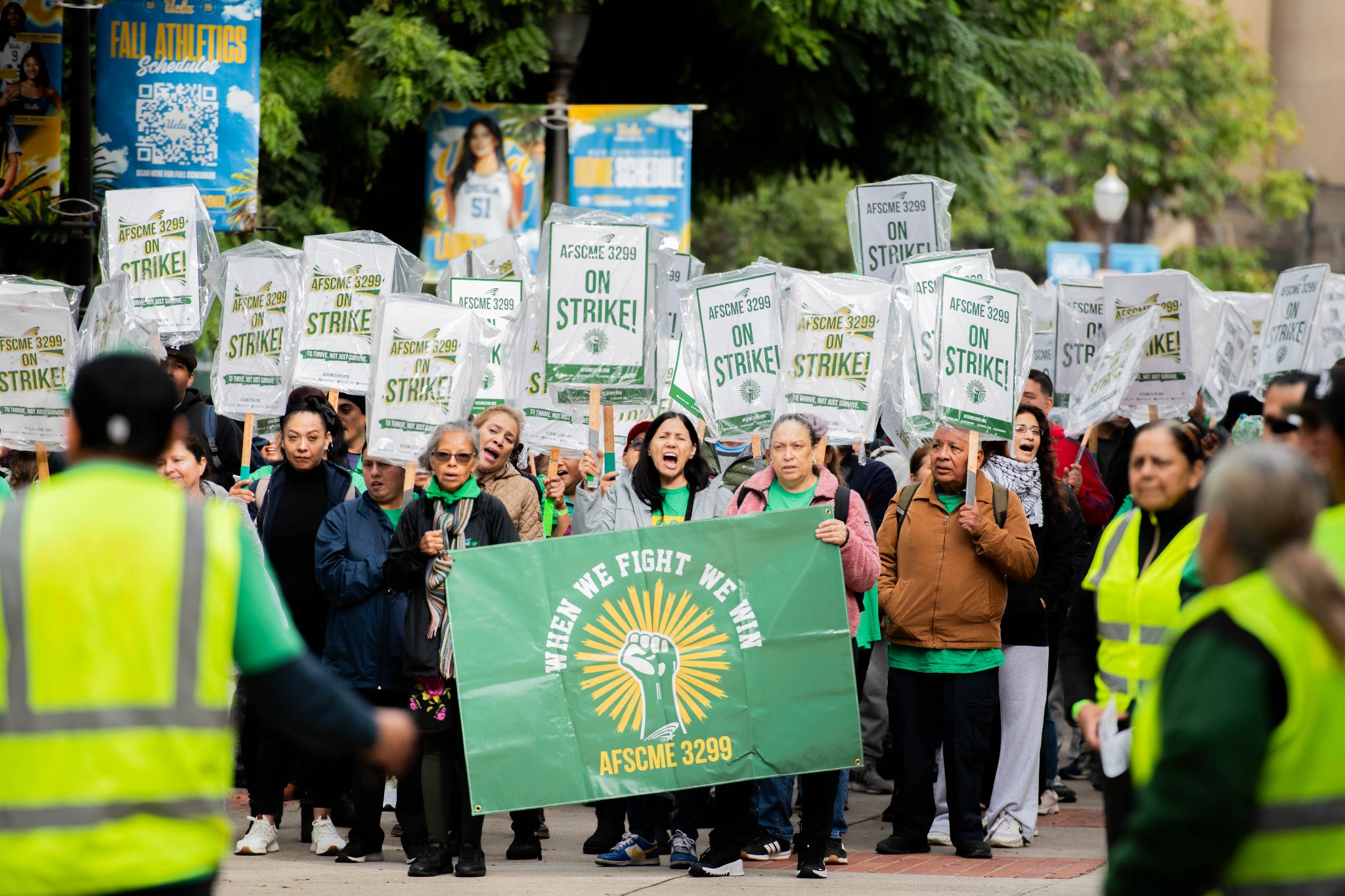
UC frontline workers force major contract victory after two-year fight
Just hours before launching their first open-ended unfair labor practice strike across the University of California system, AFSCME Local 3299 reached a tentative agreement covering more than 40,000 frontline UC workers across campuses and hospitals statewide. The victory comes after more than two years of bargaining, repeated unfair labor practice strikes, and escalating pressure against one of the largest public institutions in the country.
The workers represented by 3299 are some of the most essential – and lowest paid – in the UC system. They include patient care staff, custodians, food service workers, maintenance crews, and hospital support workers. About 30,000 of the 40,000 members work in healthcare facilities, which generate some of the largest revenue streams in the UC system. And yet, during bargaining, UC raised healthcare costs on the very workers who keep their hospitals running, even while refusing to seriously negotiate housing proposals at the table.
The tentative agreement reportedly includes 34% raises over five years, a $1,500 bonus, caps on healthcare premium increases, stronger layoff protections, expanded leave, and raises that gradually move the lowest-paid workers toward over $30/hour by 2029. Housing affordability remained the defining issue throughout bargaining, with workers describing impossible rents, multi-hour commutes, and even homelessness among workers employed by one of the wealthiest public university systems in the world.
AFSCME 3299 consistently framed their contract fight as about more than themselves. Over the past two years, workers connected their struggle to the broader housing crisis facing the entire working class, calling out billionaire real estate firms like Blackstone and speculative housing markets that have made California increasingly unaffordable. They linked their demands to attacks on immigrant communities, to public money flowing endlessly toward wars abroad – from Gaza to Iran – while workers are told there is never enough money for healthcare, housing, or wages.
This was not a quick fight. UC dragged negotiations out for years against one of the most diverse and lowest-paid workforces in the system, forcing workers to repeatedly strike and escalate. Ultimately, the credible threat of an indefinite shutdown of campuses and hospitals forced movement.
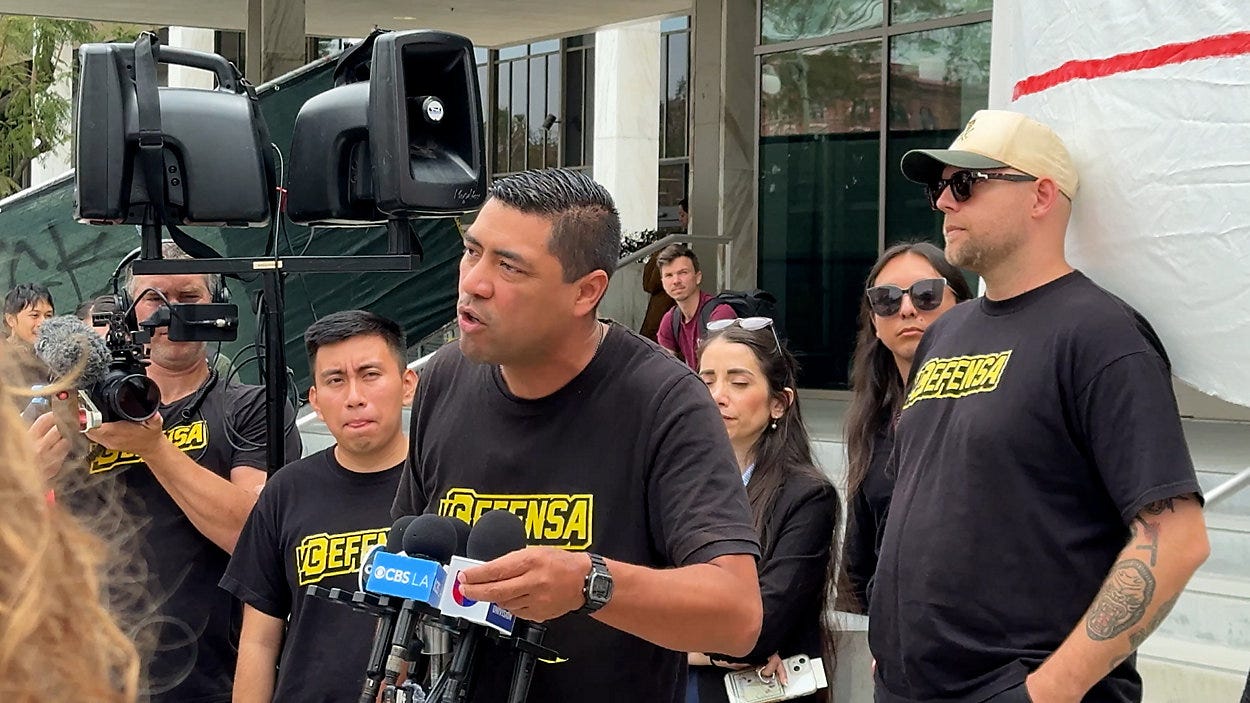
Trump escalates attacks on immigrant organizers in Ventura County
Federal agents tied to a Trump administration task force raided homes connected to VC Defensa, an immigrant rights organization in Ventura County near Los Angeles, this week, detaining volunteers and seizing electronics from organizers involved in rapid response networks defending immigrant communities from ICE raids. DHS claims organizers interfered with law enforcement. VC Defensa calls it what it looks like: an attack on people trying to protect their neighbors.
For months, immigrant communities across the country have lived under what increasingly feels like a campaign of terror – workplace raids, home raids, mass detentions, deportations, and constant surveillance. But increasingly, the administration is not only targeting immigrant communities themselves. It is targeting the people trying to organize resistance.
Groups like CHIRLA in Southern California and community defense formations like VC Defensa have played a key role to coordinate legal support, know-your-rights trainings, constitutional observation, rapid response networks, and neighborhood defense against raids. In response, the administration increasingly frames immigrant organizations as supporters of “criminality” or “terrorism” simply for documenting abuses and helping communities respond.
Over the past year, constitutional observers and labor leaders have increasingly come under attack for standing up to immigration enforcement. Last year, SEIU Union of Service Workers West President David Huerta was violently arrested by federal agents when acting as an observer and responder to immigrant raids in Los Angeles. After they brutalized and arrested him on camera, the city and labor movement mobilized to demand his release and all chargers dropped.
In Minnesota earlier this year, constitutional observers Nicole Goode and Alex Pretti – a VA nurse and AFGE member – were killed while defending their community during Operation “Metro Surge,” the largest immigration enforcement operation in U.S. history.
These attacks are not random. Their goal is clear: make people afraid to organize, afraid to document abuses, afraid to stand together to clear a path to terrorize and harass immigrant communities and any progressive or working class organization standing against the billionaire agenda.
The labor movement should recognize this for what it is – not only an attack on immigrant communities, but an attack on the very civil liberties and freedoms that make organizing possible. Because if communities can be criminalized for standing together against state violence, then the basic rights underpinning all working-class organizations are at risk too.
BONUS ROUND
Bring it to the shop!
The Pickets & Power Bulletin covers the biggest stories impacting all working people today. Share these stories with your union siblings, coworkers, friends, and family. Read it together, discuss, and take lessons to strengthen your own fights. When we fight, we win – and when we fight, we learn. Tell us in the comments about campaigns you think we should include in our next bulletin!