


Tyson workers fight sudden plant closure in Joslin
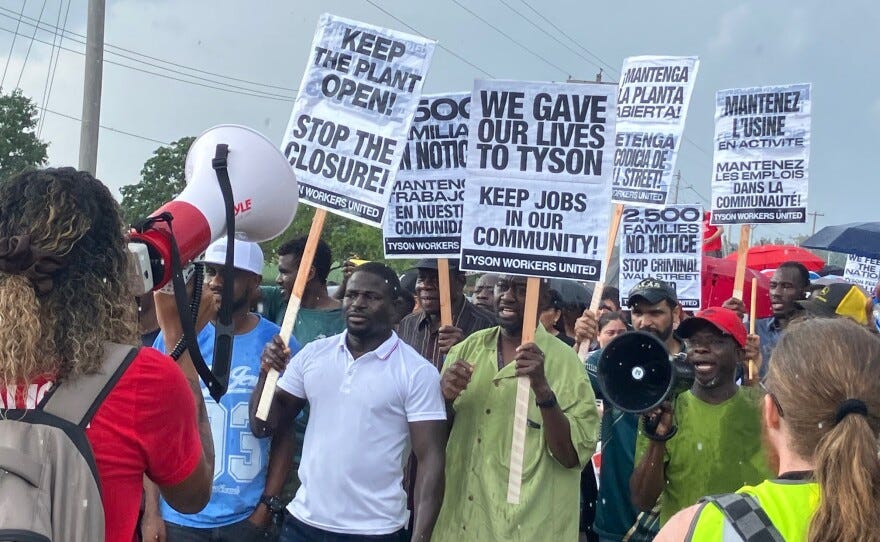
Tyson Foods has announced the sudden closure of its beef plant in Joslin, Illinois, throwing more than 2,500 union workers out of work and sending shock waves through the Quad Cities region.
The plant has been one of the most important employers in the area. For many workers, the closure came with almost no warning. Local reporting found the union was notified within roughly an hour of workers receiving notice. Most employees were told their duties would end almost immediately, even as Tyson says workers will remain employed and paid for 60 days under federal WARN requirements.
Workers and supporters rallied at the plant gates this week, demanding six months of full compensation and benefits, relief for all workers regardless of immigration status, and action to keep the plant open and preserve jobs in the community. Workers are demanding Illinois Gov. JB Pritzker buy the plant or pressure Tyson to repurpose the plant to keep it open.
Over the last several decades, the state of Illinois has given Tyson millions of dollars in tax credits and abatements for Tyson to operate in the state. Workers have also spent decades of their lives working at the plant to generate huge profits for Tyson. In reality, the workers and the state of Illinois have every right to keep the plant operational. In fact, Pritzker can use eminent domain to keep the plant gates open. The question isn’t whether or not he is legally capable of saving thousands of jobs. The question is does he have the political will to stand on the side of workers instead of billion dollar corporations like Tyson.
Tyson says the closure is driven by tight cattle supplies and rising costs. Yet, USDA data shows beef cows down only about 1%. More importantly, the company’s explanation leaves out the power meatpacking giants already hold over the industry. Tyson is one of the “Big Four” beef packers – Tyson, JBS, Cargill, and National Beef – that control over 80% of the U.S. beef market. That level of concentration gives a handful of corporations enormous power over prices, production, plant capacity, and the fate of entire communities. Tyson and Cargill have recently settled price-fixing claims in the beef industry, while other lawsuits continue against the largest packers. They deny wrongdoing, but the pattern of concentration and alleged coordination raises serious questions about who really creates the market conditions workers are now being punished for.
The Joslin plant workforce is heavily immigrant, with workers from around the world who built lives around these jobs. In towns like Joslin and the surrounding region, the meatpacking industry recruited and relied on immigrant labor for decades. Those workers helped keep the plant running and helped revive communities that had been hollowed out by deindustrialization. Now they are being cast aside, with workers on temporary work authorization especially fearful that losing their job could mean greater risk of deportation by ICE.
In fiscal 2025, Tyson reported more than $54 billion in sales and nearly $2.3 billion in adjusted operating income. CEO Donnie King himself was paid $34.5 million in 2025. The company is also continuing to invest in restructuring and capital projects while consolidating its beef operations into fewer facilities.
Workers at the Joslin plant told On the Line that the company reportedly spent millions to construct a new automated facility at the Joslin plant. More so than changes in cattle prices, that shift may indicate the company’s real motivation. Across the industry, meatpacking companies are moving toward more consolidated and automated operations that require massive capital investment. As with tech companies cutting tens of thousands of software workers to free up money for AI infrastructure, meatpackers may increasingly close older plants, abandon workers, and redirect capital toward automation.

Delta pushes AI price discrimination
Delta’s CEO Ed Bastian said AI could increase their profits by 50% through cost cutting, layoffs, and individualized price fixing for customers.
Delta has partnered with Fetcherr, an AI pricing company, to test AI-powered ticket pricing. The company previously said the system was influencing about 3% of domestic fares and that it planned to expand the technology to about 20% of its domestic network. Delta has told lawmakers in the past that it didn’t use personal data to set individualized fares and does not share personal customer information with Fetcherr.
However, Delta’s own investor language has pointed toward a future of more individualized offers, with executives describing a move away from old fare buckets toward the “right offer” at the “right time” for “you, the individual.” Lawmakers have warned that AI pricing could allow airlines to charge passengers up to each person’s personal “pain point.”
This is what AI means for companies like Delta. It isn’t making your flight better, your connection smoother, or your bag arrive faster. It gives corporations more tools to analyze demand, adjust prices, segment customers, cut labor, and squeeze more revenue from the same service.
For instance, Consumer Reports found major price gaps on Uber and Lyft for similar rides requested at the same time, with the median difference between the lowest and highest price groups across tested routes landing at 42% after corrections. One can easily imagine how airline companies could use a profile of customer search history to determine just how desperate someone is to buy a ticket, like raising prices for customers planning for a funeral or emergency medical travel.
Airline consumer protection is handled largely by the Department of Transportation, and domestic airline fares have been broadly deregulated since 1978. If AI pricing helps one airline extract more money from passengers, every other carrier will face pressure to follow.
Trump’s new NLRB majority prepares to roll back worker rights
Trump’s new majority at the National Labor Relations Board is now in place, opening the door to a major rollback of worker rights.
The Senate confirmed Trump nominee James Macy and reconfirmed Democratic member David Prouty earlier this month. Macy’s arrival gives the Board a 3-1 Republican majority, with three Trump-appointed members now holding the votes needed to overturn precedent. After Trump’s earlier firing of Democratic member Gwynne Wilcox left the Board without a quorum and created a massive backlog, the agency can now begin issuing decisions again – under a decidedly anti-worker majority.
The NLRB is one of the most critical agencies in the country for workers trying to organize. It decides what conduct counts as illegal union busting, what remedies workers can win, which workers are covered by federal labor law, and how much power bosses have during union campaigns.
Under Biden, the Board issued several decisions that modestly expanded workers’ rights. It adopted the Cemex framework, making it harder for employers to benefit from illegal union-busting during organizing campaigns. It ruled that mandatory captive-audience meetings – where bosses force workers to listen to anti-union speeches under threat of discipline – violate the National Labor Relations Act. It also strengthened remedies in some unfair labor practice cases and limited some employer tactics around severance agreements and workplace rules. Now those decisions are all on the chopping block and can be reversed.
Management-side attorneys and employer groups are already pointing to Cemex, the captive-audience meeting ban, and other Biden-era precedents as targets for reversal. If the new Board moves as expected, bosses could regain more freedom to force workers into anti-union meetings, stall union recognition, drag out elections, and violate the law with fewer consequences.
The Board could also revisit questions about which workers are covered by the NLRA at all, including independent contractors, supervisors, graduate workers, student athletes, and other workers employers have long tried to exclude from labor protections.
This is how federal labor law works in the U.S.: basic organizing rights shift back and forth depending on which party controls the White House. Workers’ rights should not depend on the political makeup of a five-member board. But for decades, employers have used the NLRB’s instability to their advantage, waiting out more pro-worker decisions and then asking Republican boards to erase them.
The result is a system where workers face endless delay while bosses adapt their union-busting playbook from one administration to the next. Meanwhile, even more worker friendly decisions have resulted in modest gains and minor changes around the edges, never delivering the transformative changes workers have demanded of labor law to truly respect their rights to organize and fight for a better life.
BONUS ROUND
Bring it to the shop!
The Pickets & Power Bulletin covers the biggest stories impacting all working people today. Share these stories with your union siblings, coworkers, friends, and family. Read it together, discuss, and take lessons to strengthen your own fights. When we fight, we win – and when we fight, we learn. Tell us in the comments about campaigns you think we should include in our next bulletin!