


Rideshare Drivers Move Toward National Breakthrough
Rideshare drivers are moving into a new phase of one of the most important private sector organizing waves in the country.
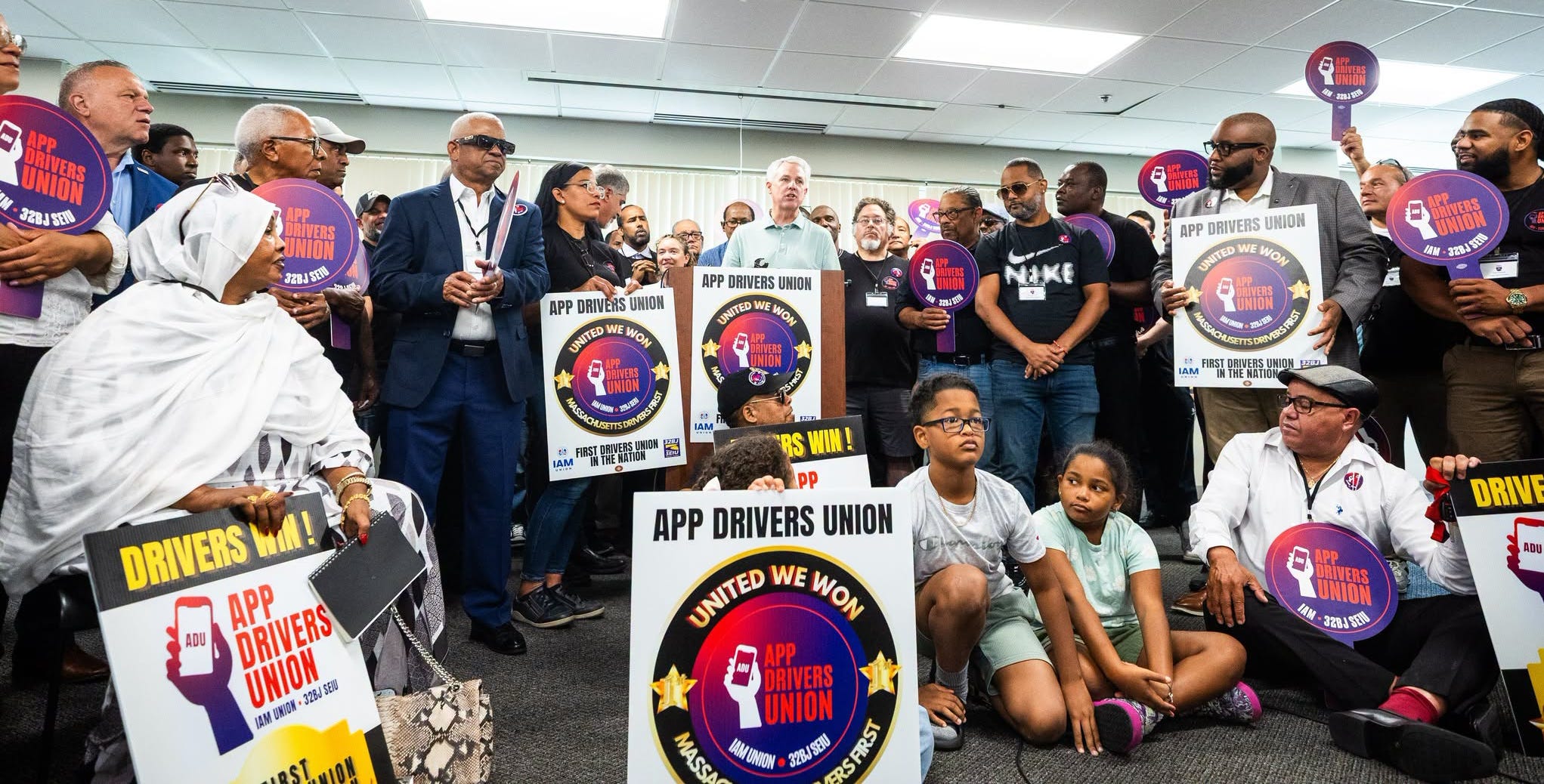
In Massachusetts, the App Drivers Union – backed by SEIU 32BJ and the IAM – has begun the process of negotiating with Uber, Lyft, and other rideshare companies after winning certification as the first recognized rideshare driver union in U.S. history. The union represents nearly 70,000 drivers across the state and for the first time has given workers the power to sit across the table from Uber and Lyft to bargain over fair wages, protection from arbitrary deactivations, and protections for driver safety.
This victory matters because app companies built their business model around denying that drivers are workers at all. Uber and Lyft have long classified drivers as independent contractors while still controlling pay, access to work, discipline, and the basic conditions of the job through opaque app systems. Drivers pay for gas, insurance, repairs, phones, cleaning, and vehicle wear while the companies take more off the top.
For drivers, the core issues are straightforward. Pay has fallen while expenses and the company’s cut keeps rising. Arbitrary deactivations can destroy a worker’s income overnight. Safety concerns are handled through corporate systems that rarely put drivers first. And drivers have little access to real benefits despite powering billion-dollar companies. Now U.S. drivers will sit down at the bargaining table for the first time with Uber and Lyft to negotiate over these same issues.
The organizing wave is spreading beyond Massachusetts too. In California, the California Gig Workers Union has filed for recognition with the state, submitting proof of driver support to the Public Employment Relations Board under AB 1340. That law created a pathway for more than 800,000 Uber and Lyft drivers in California to organize and bargain collectively while still classified as independent contractors. If the California campaign succeeds, it would become the largest rideshare organizing victory yet and one of the biggest jumps in private sector unionization in modern U.S. history.
The California campaign comes after years of companies spending millions to block drivers from winning basic rights, including the Prop 22 fight that locked drivers into second-class contractor status. The new strategy shows how unions are attempting to address a long standing and growing challenge for workers today: the gig economy. Instead of waiting for federal labor law to protect workers it excludes, drivers and unions have been building state-level frameworks that create a path to bargaining. While these victories have drawn some criticism for not eliminating the “independent contractor” designation, others have argued that the victory has finally given drivers the opening to organize and build their power for the first time to fix all the biggest problems that stem from the company’s abuse of their designation and more.
Other states are watching closely. Illinois has moved toward a similar framework for roughly 100,000 drivers, and organizers in states like Minnesota have been connected to the national rideshare organizing wave. If this spreads, millions of app-based workers could be pulled into the labor movement for the first time.
The bigger fight is not only about today’s wages and deactivations. It is also about the future of the industry. Rideshare drivers are organizing as companies expand autonomous vehicle technology that could threaten their livelihoods altogether. Drivers understand that if they do not build power now, the future of transportation will be decided entirely by Silicon Valley, Wall Street, and corporate lobbyists.
Southern Transit Workers Fight Privatization and Austerity
A wave of public transit strike threats has spread across Southern cities this Summer. In recent years, these workers are increasingly being pushed to the breaking point as privatization and austerity degrade service, working conditions, and safety across the region. The trend may continue as politicians push austerity cuts deeper to the bone, leaving workers and riders with no choice.
In Jackson, Mississippi, ATU Local 1208 members have now been on strike for more than a month against MV Transportation, the private contractor operating JTRAN. JTRAN is publicly funded, but its workforce is controlled by a private company. That means the city remains politically responsible for the service while a contractor manages the workers, wages, schedules, and daily operation.
This is the contradiction transit workers are fighting. Public officials say they want reliable service, but they outsource the system to private contractors whose basic incentive is to cut costs. Workers say MV has refused to treat them fairly, while the company has brought in replacement drivers and the city has temporarily loosened driver requirements to keep limited service running.
ATU International President John Costa called the Jackson fight “Déjà vu,” noting this is the second JTRAN strike in less than two years. He said MV Transportation’s anti-union tactics show the company cares about “making a profit on the backs of workers,” while paying inexperienced replacement drivers as much as $50 an hour instead of settling with the union.
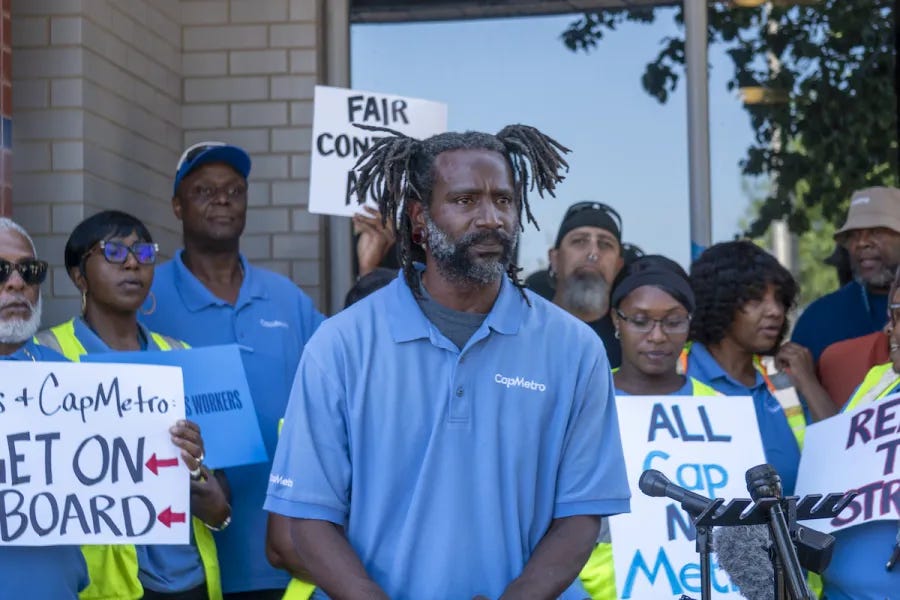
Jackson is not alone. In Austin, Texas, roughly 1,400 CapMetro bus drivers, mechanics, and other workers represented by ATU Local 1091 voted 99.5% to authorize a strike after months of negotiations with Keolis, the private contractor that operates most of CapMetro’s fixed-route bus service. A strike could shut down nearly all fixed-route bus service in Austin for the first time since 2008. Workers are fighting over wages, time off, training, and safety.
In Augusta, Georgia, transit workers represented by TWU Local 527 are also facing a possible strike at Augusta Transit. The bargaining unit includes fixed-route bus drivers, paratransit operators, mechanics, cleaner/fuelers, customer service workers, clerks, and other workers who keep the system running. MV Transportation has taken over operations under a new public-private partnership since January of this year. Workers are demanding guarantees for a 40 hour work week, raises up to $21.70 per hour, and protections from further speed-ups that cut into breaks for rest, using the bathroom, and eating meals.
The pattern is clear. Privatization worsens conditions through predictable cost-cutting. But it can also create a legal opening for strike activity, because workers employed by private contractors may have NLRA protections that direct public-sector transit workers often lack, especially in the South. Just as privatization through public-private partnerships is making public transit worse, those same transit workers have greater legal cover to strike back. The emerging transit strike wave shows that workers are beginning to challenge that model directly.
BONUS ROUND
Bring it to the shop!
The Pickets & Power Bulletin covers the biggest stories impacting all working people today. Share these stories with your union siblings, coworkers, friends, and family. Read it together, discuss, and take lessons to strengthen your own fights. When we fight, we win – and when we fight, we learn. Tell us in the comments about campaigns you think we should include in our next bulletin!