


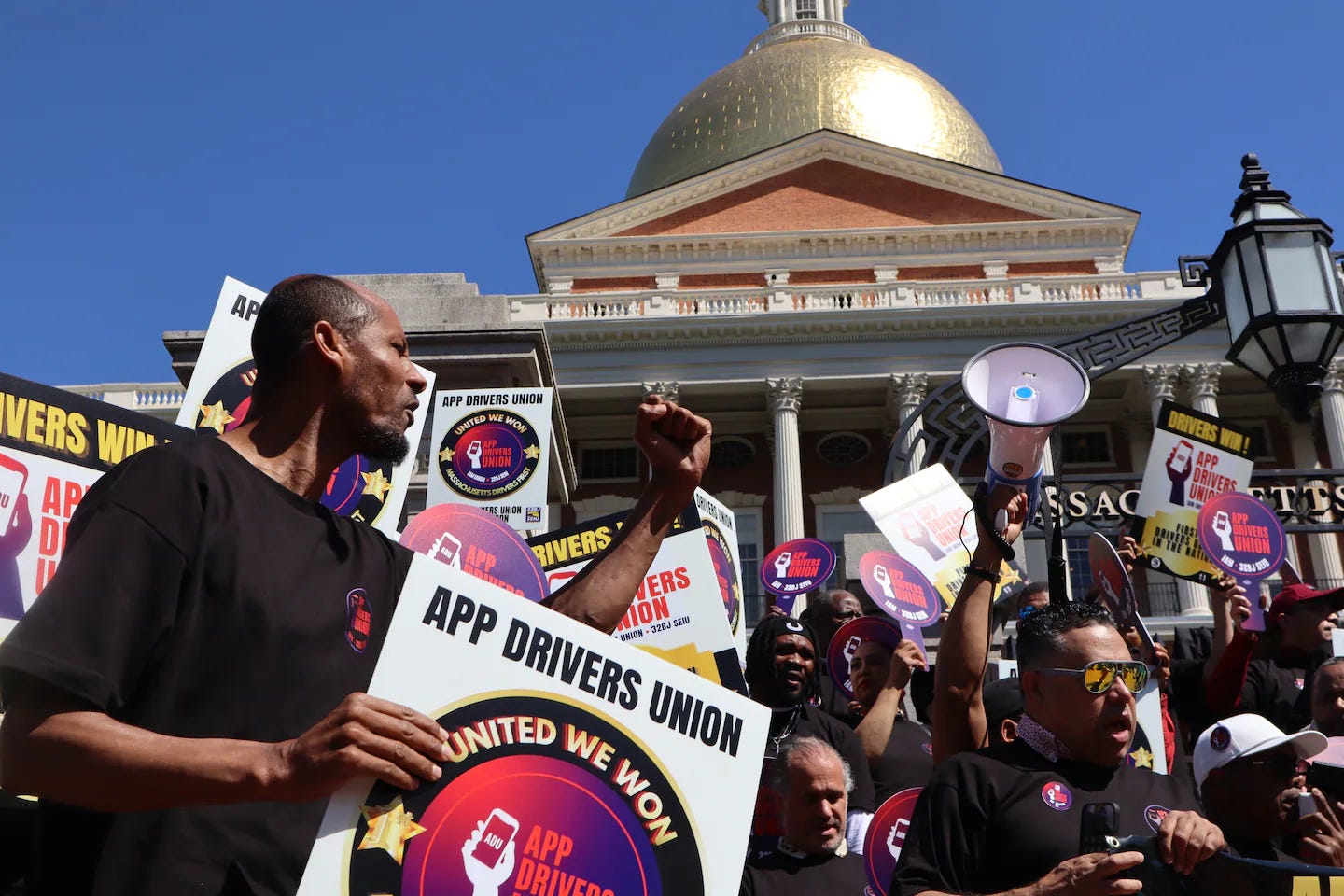
Rideshare drivers celebrate victory at MA state house. Photo: AP
70,000 rideshare drivers win first union in U.S. history
In the largest private sector organizing victory since Ford recognized the UAW in 1941, nearly 70,000 Uber and Lyft drivers in Massachusetts have officially won union recognition, creating the first certified rideshare union in U.S. history. Organized through the App Drivers Union – affiliated with SEIU 32BJ and the IAM, drivers will now be able to bargain collectively with Uber and Lyft and set standards across one of the fastest-growing sectors of the economy.
In fact, with estimates of 1.5-2.5 million drivers just in the U.S., Uber would be considered the largest employer in the country – bigger than Walmart or Amazon – if all of the drivers were recognized as Uber employees officially. Classifying drivers as independent contractors allowed Uber and Lyft to deny these workers a path to unionize through the NLRB. However, in states like Massachusetts, California, and Illinois, drivers have organized to introduce a new legal framework to organize and negotiate a union contract across the sector.
For years, rideshare companies built their business model around classifying drivers as independent contractors while exercising enormous control over their work. Drivers have faced falling real wages as vehicle costs, insurance, fuel, and maintenance expenses continue rising while the apps reportedly take a larger and larger share of fares. Many workers describe arbitrary deactivations as one of the biggest issues in the industry – a driver can lose access to work overnight with little explanation and almost no recourse.
The victory is especially significant because rideshare drivers represent one of the most immigrant-heavy workforces in the country, reportedly making up 80–90% of drivers in major markets. Workers from dozens of countries who were intentionally isolated through app-based work are beginning to organize at scale even in some of the most difficult sectors to unionize.
SEIU is already organizing toward similar efforts in Illinois, where roughly 100,000 drivers could be brought into bargaining structures, while California organizers are looking toward organizing 800,000 more app-based workers. If similar campaigns spread nationally, the rideshare industry could become one of the largest new organizing fronts in modern labor history.
Drivers are also confronting another threat looming over the industry: automation. Companies like Uber continue investing heavily in autonomous vehicle partnerships while firms like Waymo push rapid expansion. Many drivers increasingly view unionization as necessary not only to improve conditions today but to build enough power to fight for a real say in what happens as automation threatens their livelihoods.
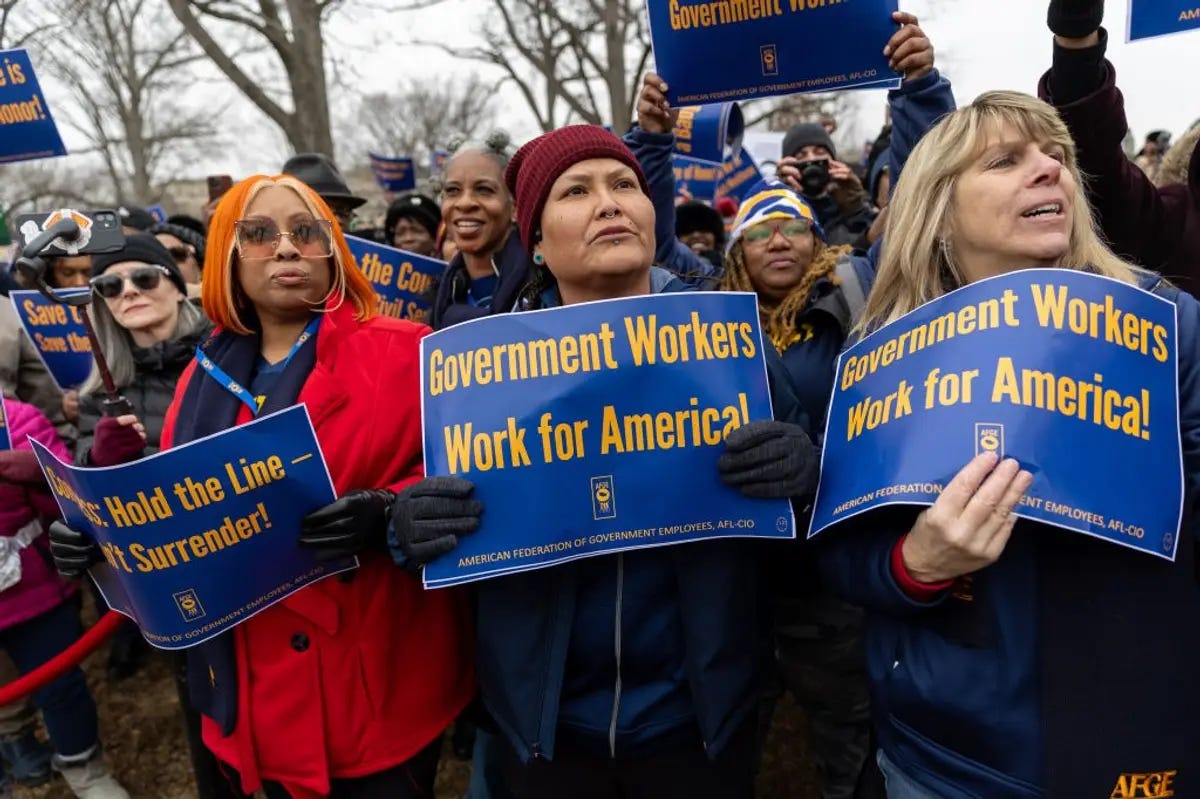
Federal workers rally in DC against government cuts in Feb 2025. Photo: Nathan Posner / Anadolu
Trump administration moves to require NDAs across federal workforce
The Office of Personnel Management announced this week that it is beginning the formal process of requiring broad nondisclosure agreements across large sections of the federal workforce, escalating the administration’s campaign to tighten control over federal employees amid growing whistleblower disclosures and public criticism.
Under the proposal, current and future federal workers could be required to sign NDAs restricting disclosure of a wide range of internal information. Violations could expose workers to civil and criminal penalties. OPM says the proposal is aimed at stopping leaks involving sensitive government operations, citing the leaks of the governments planning around the unpopular operations to kidnap Venezuelan President Nicholas Maduro.
The American Federation of Government Employees – the largest union of federal workers – warned that the proposal is part of a broader effort to silence dissent, intimidate workers, and weaken independent civil service protections. They point out that existing laws already govern classified information and that the proposal is meant to create a chilling effect throughout the federal workforce.
The proposal arrives after months of turmoil across federal agencies. Since returning to office, Trump has overseen sweeping layoffs, workforce reductions, agency restructuring, and DOGE-driven cuts across federal programs. The administration has also moved to terminate collective bargaining agreements in parts of the federal workforce and expand pathways for removing career civil servants.
At the same time, some of the most significant reporting on the administration this year has come from federal workers themselves – including disclosures involving immigration enforcement operations, agency cuts, retaliation against employees, and internal resistance to administration directives. OPM argues the new rules are necessary to stop damaging leaks. Federal workers increasingly fear they are being used to suppress lawful whistleblowing and criticism.
For labor unions representing federal employees, the concern goes beyond leaks. The fear is that the administration is steadily constructing a federal workforce where workers are expected to demonstrate loyalty, remain silent, and avoid speaking out about abuses – even as agencies undergo some of the most dramatic restructuring in modern history.
Federal unions have filed lawsuits to block many of these attacks, but mostly to little avail. The mass layoffs pushed by DOGE have been challenged, but most laid off workers remain in limbo without work. Federal contracts have been voided and ignored by agencies, with unions losing their office space and needed resources. Legal strategies – adopted as the primary shield by federal unions – have shown limited success in reversing or showing these attacks, with organizations like AFGE bleeding resources and membership.
As the workforce is hit by these attacks, members of the Federal Unionists Network – a multi-union formation of federal workers – have advocated to organize urgently to protect against these attacks, calling for more collective action and the need to break out of the usual playbook for federal unions to survive. One of their main strategies has been working with whistle blowers in the federal workforce to call out the attacks on federal services and the workers who provide them. With the authority and expertise on these systems, they are raising the alarm as the Trump administration attempts to break down these public goods. The Trump administration is now trying to crack down on whistle blowers to ensure the public is kept in the dark.
Big Tech starts pumping the brakes on AI hype
After spending years telling investors that artificial intelligence would transform productivity and justify massive restructuring, some of the companies leading the AI rush are beginning to quietly acknowledge a problem. The tools are costing enormous amounts of money – and many companies still aren’t seeing the returns they expected.
This week, reports emerged that Microsoft has begun cutting access to certain AI coding tools internally, including Claude Code licenses, after costs ballooned across parts of the company. At the same time, Uber executives publicly questioned whether the company’s massive AI spending is actually producing meaningful improvements for workers or customers. Uber reportedly burned through its entire planned 2026 AI budget within four months.
The shift comes after years of unprecedented spending. Microsoft alone expects to spend nearly $200 billion in 2026, much of it tied to AI infrastructure, while companies across tech have collectively poured over $700 billion into data centers, chips, cloud computing, and enterprise AI contracts.
At the same time, workers have paid the price. Companies including Meta, Microsoft, Salesforce, Amazon, and Block have collectively eliminated hundreds of thousands of jobs while arguing AI would make organizations more efficient. Earlier this month, Meta cut another 8,000 workers as part of plans to eliminate up to 20,000 jobs this year, even while posting massive profits.
What makes this moment notable is not that companies are abandoning AI – they aren’t. Instead, some of the firms most aggressively pushing adoption are beginning to realize that AI is not magically reducing costs at the speed investors expected. In some cases, companies are discovering that maintaining massive AI systems, computing infrastructure, and enterprise contracts can be more expensive than anticipated without guarantees of major improvements.
That does not mean the threat to workers disappears. Companies are still restructuring around AI, slowing hiring, raising productivity expectations, and searching for ways to reduce labor costs. But cracks are beginning to emerge in the narrative that AI would immediately revolutionize everything while effortlessly generating profits. The deeper question now is whether the AI boom is creating a sustainable transformation of the economy – or whether parts of the industry are beginning to resemble more of a speculative bubble fueled by endless spending and investor hype.
Bring it to the shop!
The Pickets & Power Bulletin covers the biggest stories impacting all working people today. Share these stories with your union siblings, coworkers, friends, and family. Read it together, discuss, and take lessons to strengthen your own fights. When we fight, we win – and when we fight, we learn. Tell us in the comments about campaigns you think we should include in our next bulletin!