



Chicago schools join May Day shutdown
The Chicago Teachers Union (CTU) has successfully pushed Chicago Public Schools after weeks of pressure to make May 1 a day of civic engagement for all Chicago public school students to allow over 300,000 students and over 40,000 educators to join the May Day national shutdown movement – calling for “no work, no school, no shopping.”
CPS will remain open, yet May 1 will be treated as a “day of civic action,” with students and educators allowed to participate in protests, and schools encouraged to facilitate attendance at rallies as part of the school day. This is motivated by the Trump administration’s attacks on public education and more broadly against the working class families who send their children to CPS. As a part of the agreement, CPS will even be providing buses to transport students and educators to the rally downtown.
Under pressure from organized labor, one of the largest school districts in the country is now formally recognizing mass protest as part of civic education. In the birthplace of May Day and the center of the May Day Strong coalition, more workers, students, and families will now prepare to join mass protest actions in the streets.
70,000 LA educators win major contracts
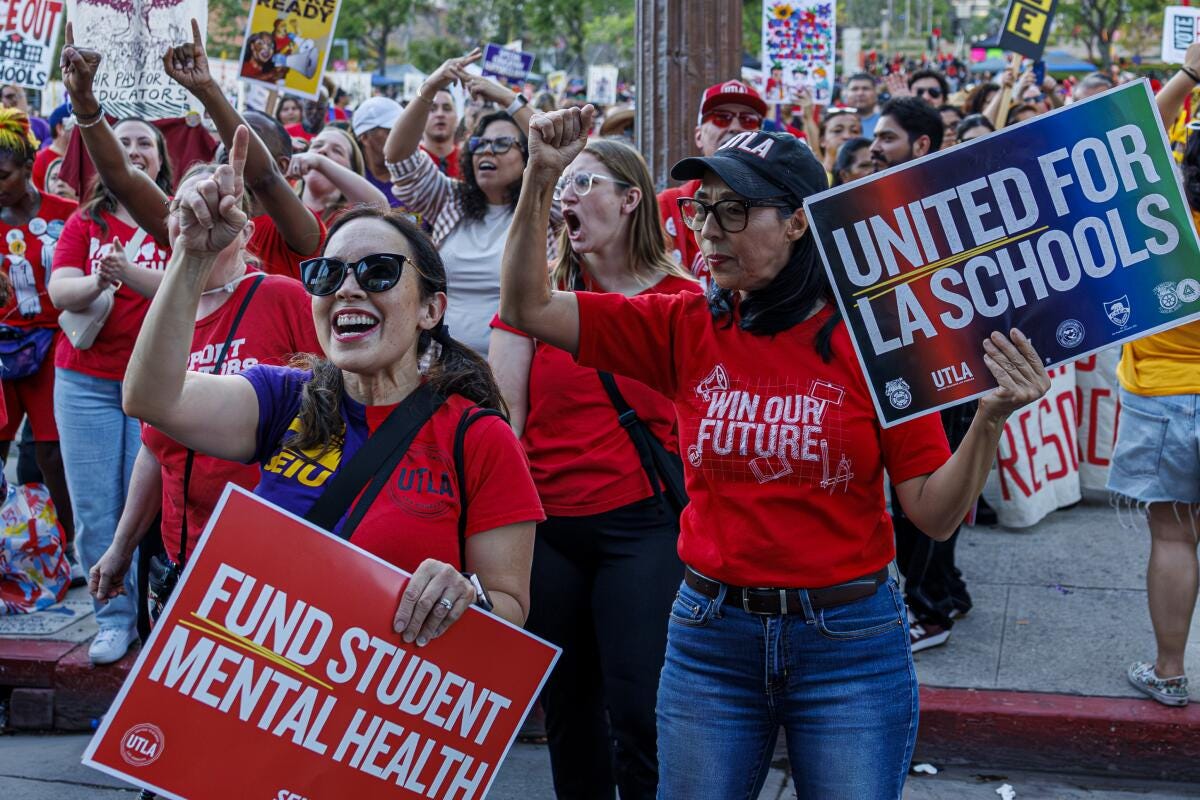
In Los Angeles, over 70,000 educators won major contract gains and narrowly averted a massive strike across the second-largest school district in the country. Three unions – UTLA, SEIU Local 99, and AALA (IBT 2010) – were bargaining simultaneously with LAUSD, bringing negotiations down to the wire. As each union reached a tentative agreement, they maintained a united strike threat until the final deal, showing that no group would settle until every school worker secured a fair contract.
That leverage produced major gains. Teachers won raises averaging nearly 14%, with larger increases for early-career educators to help stabilize a workforce strained by the cost of living. School workers secured higher wages, additional hours, and protections against subcontracting and layoffs, while administrators won raises and more flexibility in workload. The agreements also included provisions on class size enforcement, special education support, and protections against unchecked AI implementation in schools.
This marks the high point of the California Teachers Association’s “We Can’t Wait” campaign, which has mobilized over 80,000 educators statewide. From Richmond to San Francisco to Sacramento and now Los Angeles, the strategy has been consistent – build coordinated campaigns, create credible strike threats, and raise standards across the sector.
Like other recent education fights, this was also about students’ learning conditions. Educators were organizing in response to housing instability, cuts to social programs, and the fear caused by ICE enforcement in immigrant communities. Schools are being asked to absorb these pressures while districts sit on billions in reserves.
The campaign shows how educators can link local fights into a broader movement for education justice. California is the fourth-largest economy in the world, yet public education remains underfunded. Now the focus is shifting from district-by-district fights to demanding that the state fully fund public education.
NYC building workers beat back real estate billionaires
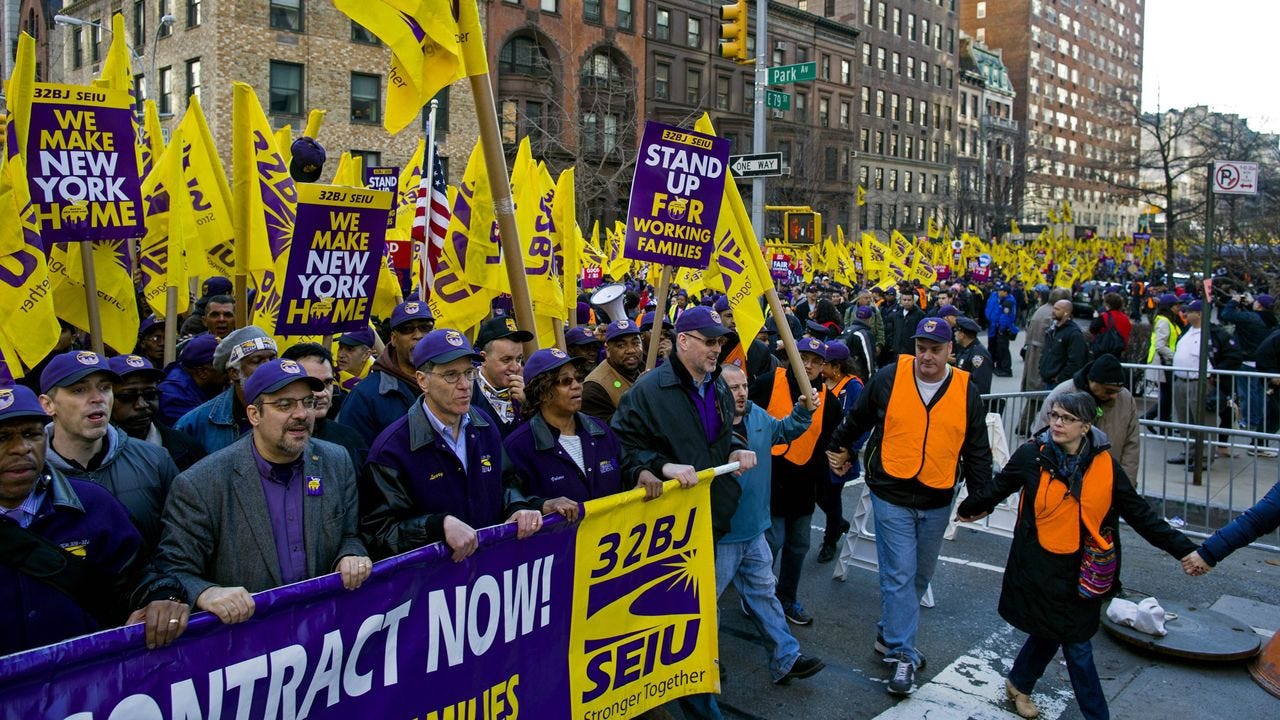
In New York City, 34,000 building service workers with SEIU 32BJ forced a major contract settlement after preparing for a strike that would have hit the heart of the most valuable real estate market in the world for the first time since 1991.
Their employer counterpart, the Realty Advisory Board, represents many of the biggest real estate interests in the world. The RAB was formed in the 1930s explicitly to break the union just as building service workers were getting organized. These are the landlords and developers who control billions in property across Manhattan and beyond – an industry built on some of the highest rents and property values on the planet. Those same corporate landlords have been a major factor driving the out of control affordability crisis in New York City. Building service workers themselves have been feeling the rising costs push them out of the city along with their working class neighbors.
And yet, even here, the employers came to the table demanding concessions from the union. They pushed to cut healthcare benefits and introduce a two-tier system that would permanently divide new workers from the rest of the workforce, ensuring everyone hired going forward would have to accept lower pay and benefits. The RAB claimed they could not afford to maintain or improve the pay and benefits of building service workers, citing the possibility of rent freezes as a coming crisis for corporate landlords.
Workers refused to sell out future generations or accept cuts themselves. After a massive strike vote and public mobilization this past week, they won a deal that not only defeated the RAB attempts to cut health benefits and introduce a two-tier contract, but actually won $4.50 per hour in raises by the end of the 4-year agreement and a 15% increase to their guaranteed pension.
Even in the most profitable industries, employers are trying to claw back standards by targeting the next generation of workers. Similar two-tier contracts were pushed on auto workers and UPS workers in decades past, undermining the unity of the workforce and the integrity of their contracts. Those two-tier systems in auto and UPS were ultimately defeated in recent years through powerful strikes and strike threats.
Nurses take the fight against ICE to Congress
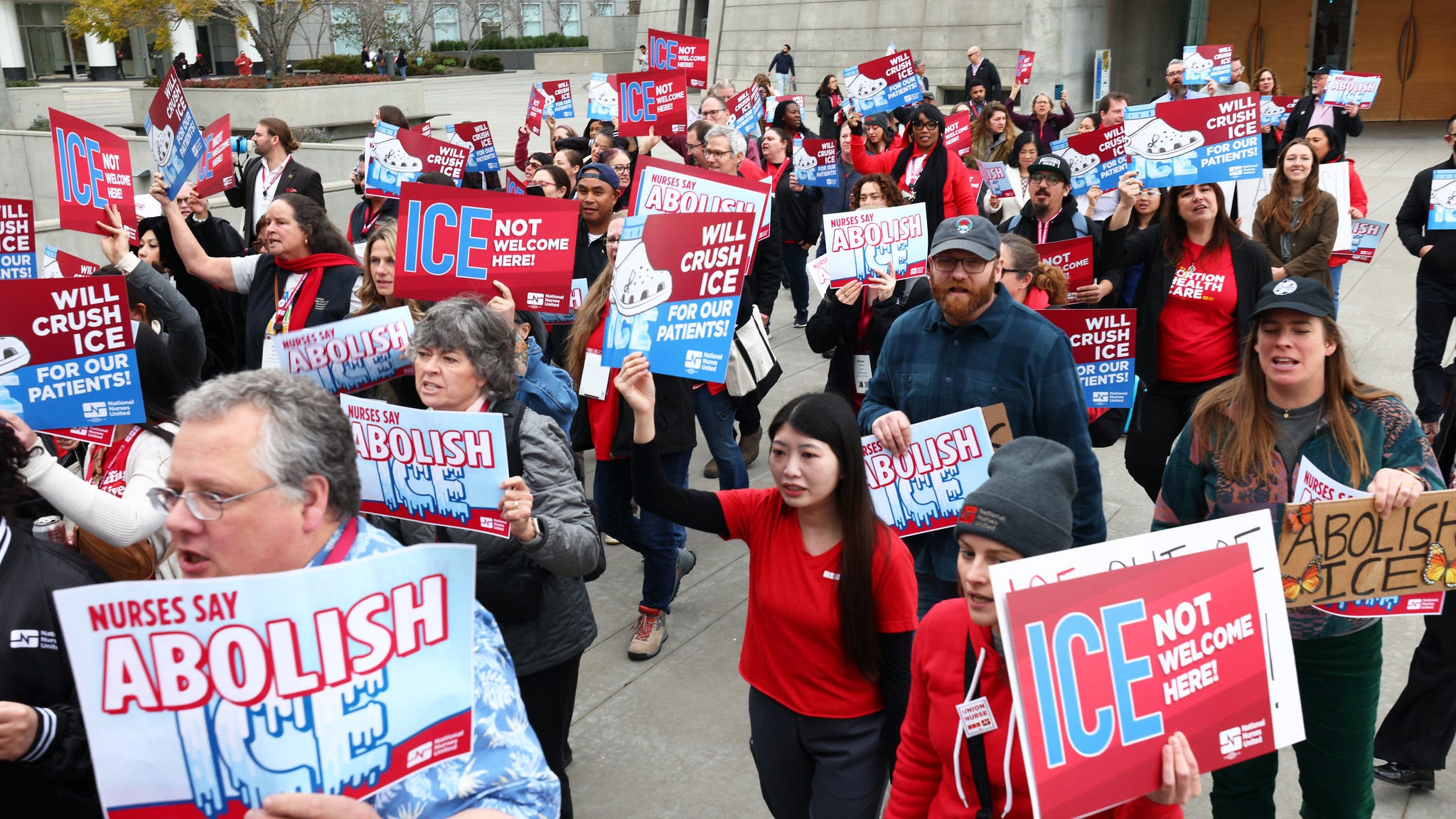
This week in Washington, DC, members of National Nurses United – representing over 225,000 nurses nationwide – rallied with a clear message: ICE is not just an immigration issue, it is a healthcare issue. Nurses are on the front lines of what immigration enforcement does to communities. Patients avoid seeking care out of fear. Consequently, families delay treatment until conditions become emergencies. Entire communities are destabilized, and hospitals are forced to operate in the middle of that crisis.
After the murder of Alex Pretti – a VA nurse and AFGE union member, executed by federal agents in January as a consequence of the federal occupation of Minnesota – NNU sprung into action to condemn the murder and called to abolish ICE to curb their violent terror campaign. By taking up the call to abolish ICE, NNU is expanding what it means to defend their workplaces against new threats growing under the Trump administration. Healthcare workers are making the case that protecting patients requires confronting the broader systems that are harming them outside the hospital walls.
That includes speaking out against the massive public spending on war and deportation, while healthcare systems remain underfunded and overstretched. Massive cuts under Trump’s “Big Beautiful Bill” – including a trillion dollar cut to Medicaid – have been used to fund trillions in tax breaks for the billionaires, the deportation machine, and endless war.

Layoffs spread as corporations double down on AI and cost-cutting
Another wave of layoffs hit major corporations this week, reinforcing a pattern that is becoming impossible to ignore. Disney cut around 1,000 jobs across its operations despite generating roughly $12 billion in profits last year. The cuts hit major divisions including Marvel and ESPN, with leadership framing the layoffs as part of becoming more “technologically enabled” – a familiar phrase that signals a deeper push toward automation and AI-driven restructuring.
At the same time, Snap announced layoffs of about 1,000 workers as well – roughly 16% of its global workforce – explicitly tying the cuts to its increasing reliance on AI tools. The company has told investors that 65% of new code is already being generated by AI systems, and that it intends to accelerate that shift even further. At the same time, Meta has announced they will layoff 10% of their workforce next month as part of the mass layoffs they announced last month to cut 20% total in the near future. This comes as Meta continues to aggressively integrate AI into every area possible.
Markets have rewarded these moves. Companies cut workers, promise future gains through AI, and see their valuations rise. AI driven mass layoffs have become a regular feature of both tech and entertainment, and other sectors are likely to follow. The more major companies announce such layoffs, investors and corporate America will continue to feel the competitive pressure to do the same, accelerating the trend further.
BONUS ROUND
Bring it to the shop!
The Pickets & Power Bulletin covers the biggest stories impacting all working people today. Share these stories with your union siblings, coworkers, friends, and family. Read it together, discuss, and take lessons to strengthen your own fights. When we fight, we win – and when we fight, we learn. Tell us in the comments about campaigns you think we should include in our next bulletin!