


SF Educators Win Contract After Historic Strike; MN Labor and Community Groups Organize for March 1st Rent Strike; NYSNA Nurses Win Contracts Across Hospital Systems
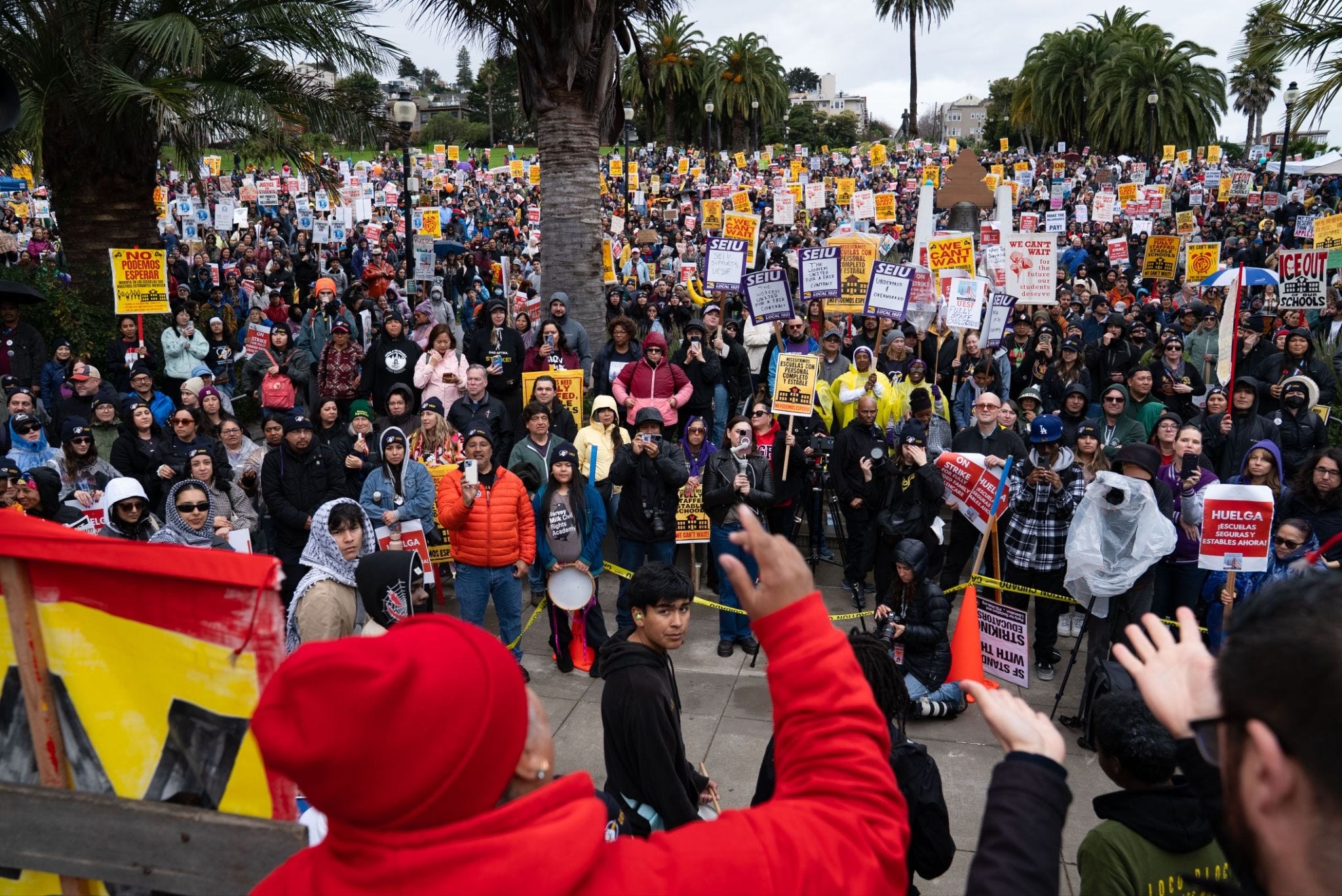
San Francisco educators end historic strike with major contract wins
Educators with the United Educators of San Francisco (UESF) ended their first strike since 1979 after reaching a tentative agreement with the district on a historic new contract that delivered major gains on fully funded family healthcare, wages, support for special education, and protections for sanctuary schools and housing programs for students and families. The strike, which shut down schools for four days, drew strong backing from parents and community organizations and forced the district back to the bargaining table after months of stalled negotiations.
The strike’s success is already reverberating across California, showing that coordinated escalation and strong community alignment can overcome claims of budget crisis from school districts and politicians. The win comes as contract campaigns continue heating up across the state as part of the California Teachers Association’s “We Can’t Wait” campaign, with educators in Oakland, the Sacramento region, and Los Angeles preparing to follow SF and, if needed, strike for the schools their students deserve.
The campaign links local contract fights into a statewide push for fully funded schools, smaller class sizes, and improved educator pay. Despite being the richest state in the country, CA ranks 33rd for per pupil spending on public education. Now educators, students, and families are demanding the billionaires and politicians fully fund public education, and protect public schools from the attacks of the Trump administration.
🎥After decades of cuts, SF educators say “Enough is enough!”
🎥SF students confront district: “Where is Superintendent Su?”
Minnesota rent strike called for March 1st by community and labor groups
Tenant groups, community organizations, and labor unions in the Twin Cities are organizing toward a March 1, 2026 rent strike, calling on tenants to withhold rent unless the state moves to stop evictions and provide emergency relief for working-class families hit hardest by recent ICE terror under operation “Metro Surge.”
The rent strike has been endorsed by a range of unions, including SEIU Healthcare MN/IA, SEIU Local 26, Unite HERE Local 17, ATU 1005, and CWA 7250 – collectively representing nearly 26,000 workers. Organizers are demanding an eviction freeze, $50 million in emergency rent relief, and protections for immigrant and working-class tenants facing displacement.
The rent strike call follows the wave of mass actions in January, including the January 23 general strike day of action in Minnesota and the January 30 national shutdown protests, where workers, students, and community members walked out, shut down businesses, and filled the streets to oppose ICE terror after the killing of Renée Good and Alex Pretti. A rent strike of this scale could be the largest rent strike in the country in decades.
NYSNA nurses strike ends with contract victory at NewYork-Presbyterian
After a month on strike, over 15,000 nurses with the New York State Nurses Association (NYSNA) secured tentative agreements and ratifications at Mount Sinai, Montefiore, and NewYork-Presbyterian hospital systems, winning gains on staffing, workplace violence protections, AI safeguards, and pay increases. This marks the end of one of the largest and longest nurses strikes in recent history.
Over 10,000 nurses at Mount Sinai and Montefiore hospital systems reached agreements last week, while 4,000 nurses at NewYork-Presbyterian held the line until Friday to reach their agreement after rejecting a proposed deal, keeping pressure on one of the city’s wealthiest hospital systems.
At the center of the fight are demands for safe staffing levels, to ensure adequate patient care and prevent burnout and violence against nurses. Just this week an arbitrator awarded nurses ay NewYork-Presbyterian over $400,000 in damages for over 600 violations of safe staffing rules. The fight for safe staffing levels has become the defining fight for union healthcare nurses across the country, exacerbated by the COVID-19 pandemic retention and burnout crisis and recent federal cuts to Medicaid.
WNBA negotiations enter final stretch with strike threat growing
Negotiations between the league and the Women’s National Basketball Players Association (WNBPA) continued this week without a finalized agreement, leaving the possibility of a strike hanging over the start of the 2026 season. Players remain focused on revenue sharing, salary growth, charter travel protections, and workload standards, with a 98% strike authorization vote signaling overwhelming support for escalation if needed.
Reports indicate both sides have exchanged counterproposals, but key economic issues remain at the core. The league has been growing immensely in popularity in recent years, which has come with rapidly growing commercial success. Despite this growth, the owners have been refusing to give players their fair share of that success they’ve driven themselves on the court.
Federal workers face new threats to collective bargaining
This week, the Office of Personnel Management reportedly directed federal agencies to move toward terminating existing union contracts covering federal workers. This shows the Trump administration continuing to undermine collective bargaining rights of federal workers to clear a path for more mass layoffs and dismantling of federal services even amid ongoing legal action.
At the same time, groups of federal workers are organizing to push back. The National Association of Letter Carriers (NALC) is holding coordinated contract campaign actions this coming Sunday, ahead of the start of national bargaining for postal workers. At the core of the fight, members are calling to end the two tier system of non-career positions, demanding COLA raises, and protections from management abuses.
Additionally, workers are organizing to defend the postal service from threats of privatization. They say privatization will undermine the country’s oldest public good and turn service guarantees into critical service gaps and price hikes. Privatization would also be destabilizing to the postal workers themselves.
The fight highlights a broader reality for federal workers heading into 2026: workers are not only bargaining over wages and conditions, but increasingly defending the very structure of public services against austerity and privatization pressures.
No evictions under occupation!! Thank you OTL for this easy read, it’s been hard to keep up with all the actions these past two months 😅