


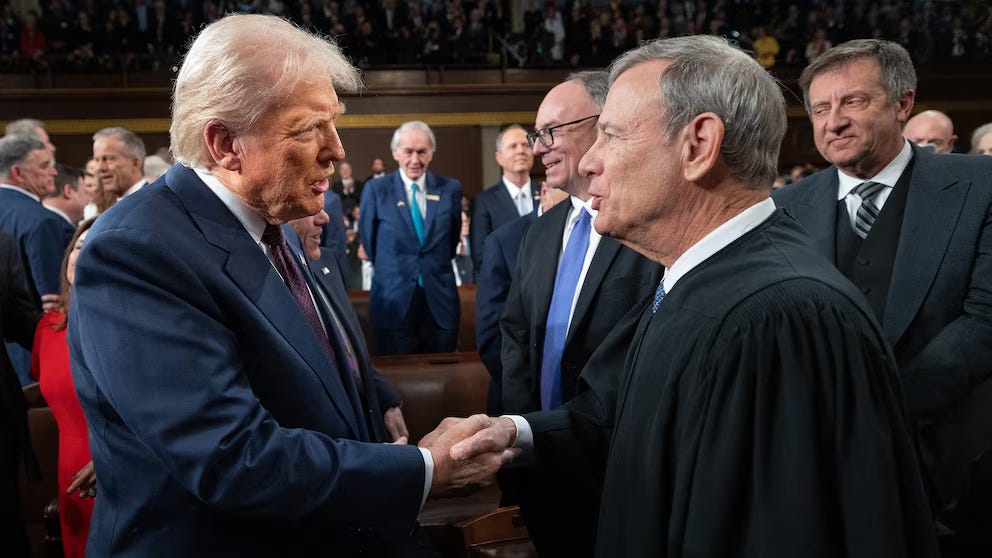
Supreme Court closes term by backing Trump, billionaires, and the right-wing culture war
The Supreme Court ended its term with another round of decisions expanding presidential power, weakening limits on big money in politics, and validating one of the right’s central anti-trans campaigns.
The rulings came just days after the Court also sided with Trump’s deportation agenda, allowing the administration to terminate Temporary Protected Status for Haitians and Syrians and revive “metering” at the border, making it easier to turn asylum seekers away before they can even make their claim. Those immigration rulings immediately threaten roughly 350,000 Haitians and more than 6,000 Syrians, while opening the door to attacks on a broader TPS population of nearly 1.3 million people. Our last bulletin covers this decision and its implications.
Then came campaign finance. In National Republican Senatorial Committee v. FEC, the Court struck down federal limits on how much political parties can spend in coordination with candidates. The 6–3 ruling overturns a major limit that had been upheld in 2001 and gives party committees far more room to directly coordinate campaign strategy, advertising, and spending with candidates.
This is the most significant campaign finance ruling since Citizens United. That 2010 decision helped open the floodgates to unlimited independent political spending, fueling the rise of Super PACs and dark money. Now the Court has gone further, removing caps on party coordinated expenditures too. The result is another gift to the rich: more money, more coordination, and more ways for wealthy donors and corporate interests to shape elections and the country’s politics. Justice Elena Kagan warned in a dissenting opinion that the ruling opens new opportunities for corruption.
The Court also issued a major ruling on executive power in Trump v. Slaughter, holding that Trump had authority to remove FTC Commissioner Rebecca Slaughter and weakening the long-standing independence of federal regulatory agencies. The ruling gives the president more direct control over agencies like the FTC, SEC, FCC, and NLRB, making it easier to fire officials who refuse to carry out the administration’s agenda.
Agencies like the NLRB and FTC are supposed to enforce rules against union busting, corporate abuse, monopolies, fraud, and unfair labor practices. If those agencies become direct tools of the White House disciplined to Trump’s agenda, then enforcement can be bent even more openly toward the political needs of the administration and the corporate class behind it.
On the same day, the Court treated the Federal Reserve differently, allowing Fed Governor Lisa Cook to remain in office while litigation continues. That split shows the politics clearly: the Court is willing to weaken the independence of agencies that regulate corporations, labor, consumer protection, and communications, while moving more cautiously around the institution most central to the stability of finance capital.
Finally, in West Virginia v. B.P.J., the Court ruled that states can ban transgender women from women’s school sports. The decision upheld laws in West Virginia and Idaho and found that such bans do not violate Title IX or the Equal Protection Clause.
The right has turned trans athletes into a national panic over a problem that doesn’t exist. NCAA President Charlie Baker told Congress in 2024 that he knew of fewer than 10 trans athletes among more than 500,000 NCAA athletes. That is around 0.002%. But Trump made the issue a central piece of his political brand, using trans people as scapegoats while his administration attacks healthcare, schools, student loans, and working-class families.
On July 1, new student loan restrictions under Trump’s H.R. 1 took effect, phasing out Grad PLUS loans for new borrowers and adding new borrowing caps on student loans. So while the right claims to be defending women’s opportunities in college sports, it is making higher education itself less accessible to working-class families.
Taken together, the Court’s message is clear. More power for presidents. More power for billionaires. More power for corporations. More power for states to target trans people. Less protection for immigrants, workers, voters, and marginalized communities.
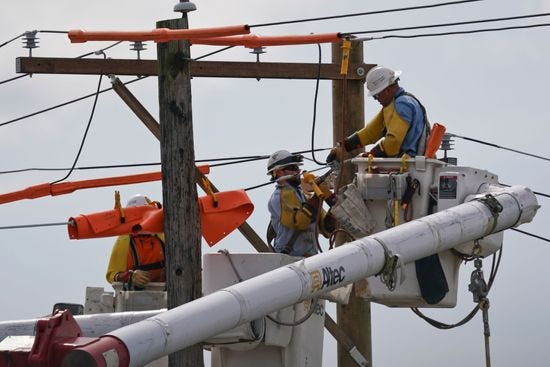
Utility workers strike in Philadelphia as America turns 250
On July 4, 1,600 utility workers at PECO, represented by IBEW Local 614, went on strike after months of negotiations failed to produce a fair contract. PECO is the utility giant serving roughly 1.6 million electric customers and more than 500,000 natural gas customers across Philadelphia and southeastern Pennsylvania. Its workers include linemen, gas technicians, mechanics, call center staff, and back-office workers who keep the region’s power and gas systems running.
The strike comes as Philadelphia sits on the national stage for America’s 250th anniversary. Up to 1 million people were expected in the city for July 4 events, including concerts, fireworks, and World Cup festivities. The timing gave PECO workers enormous leverage, especially as a dangerous heat wave pushed temperatures into the 100s and strained the region’s infrastructure.
Workers say the company failed to make serious counterproposals after negotiations began in January and their contract expired April 1. PECO workers are paid about 30% less than comparable utility workers elsewhere in Pennsylvania. They are demanding raises that keep up with the cost of living, along with improvements to benefits and retirement. The union also says PECO opened disciplinary cases against 150 members to intimidate workers after the strike announcement, before ultimately putting those cases on hold after pushback from the union.
The strike comes after PECO reported major profits and while Exelon, its parent company, continues to reward executives. PECO reported $278 million in profit in just the first quarter of 2026, while Exelon CEO Calvin Butler got more than $24 million in 2025.
Workers keep the lights on during heat waves, holidays, and national celebrations, while executives cash the checks. And when the country gathered in Philadelphia to celebrate independence, PECO workers used the moment to demand some power of their own.
BONUS ROUND
Bring it to the shop!
The Pickets & Power Bulletin covers the biggest stories impacting all working people today. Share these stories with your union siblings, coworkers, friends, and family. Read it together, discuss, and take lessons to strengthen your own fights. When we fight, we win – and when we fight, we learn. Tell us in the comments about campaigns you think we should include in our next bulletin!