


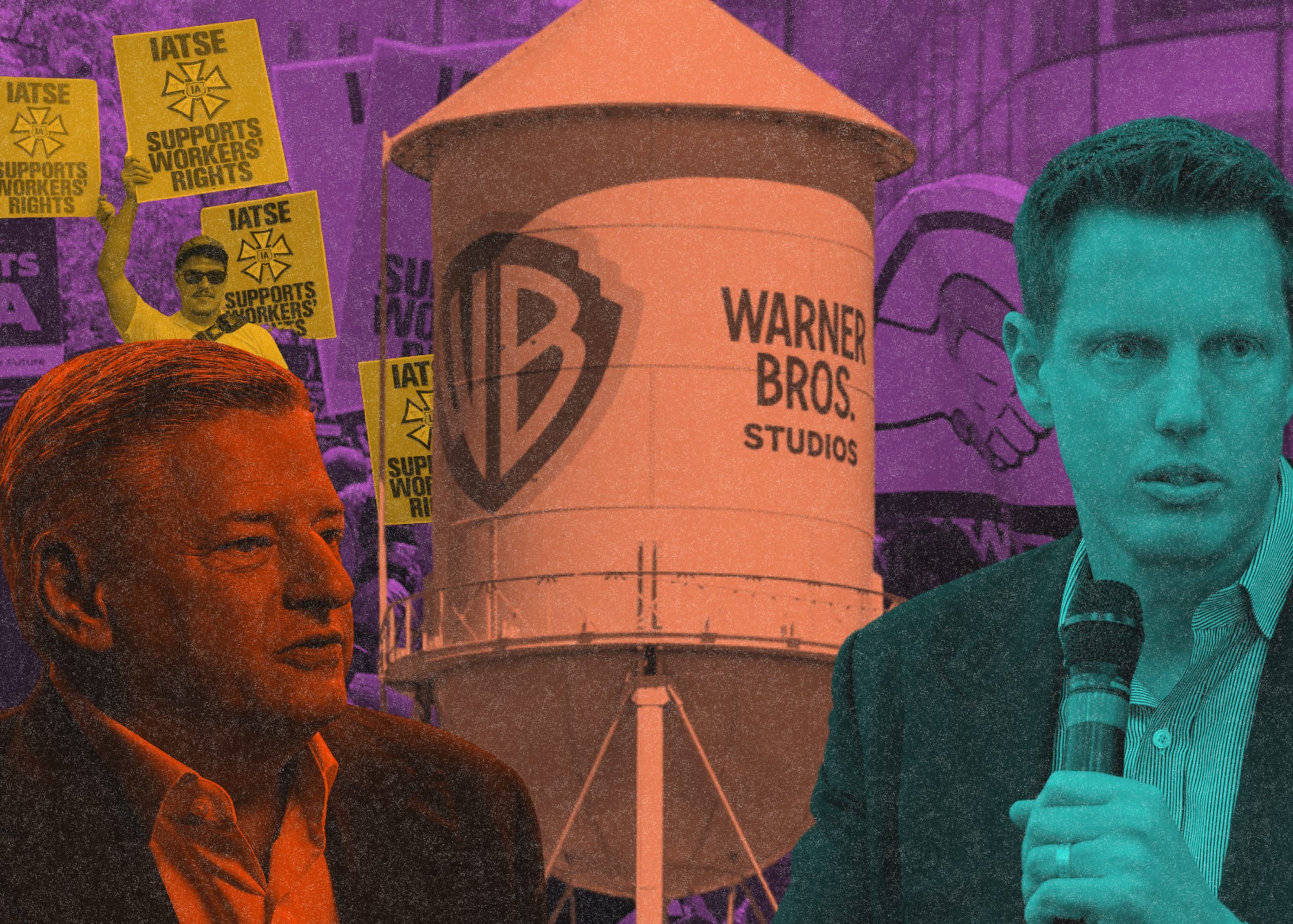
On the Line interviewed Rhianna Shaheen, a Los Angeles-based Assistant Production Coordinator in Film and TV and a member of IATSE Local 871 Board of Directors.
Jeff Rosenberg (JR): After months of this unfolding corporate drama, yesterday Paramount appears to have come out on top in a sort of twist, with Netflix pulling out their bid to acquire Warner Bros Discovery (WBD). In the conversation around this megamerger bidding war, we are hearing all about the schemes and power moves of Netflix vs Paramount – both giant corporations, and billionaires with big egos like Trump and Ellison. What is actually happening with this corporate bidding war and consolidation?
Rhianna Shaheen (RS): What’s happening with the WBD bidding war is the latest chapter in Hollywood’s oldest story: consolidation. We’ve seen battles like this before, but the players are different and the stakes are much higher.
For anyone who works in this industry, none of this is surprising. Hollywood more or less started with consolidation. In the 1920s, the original “Big Five” studios dominated the industry by squeezing out independent producers and theater chains. That pattern never disappeared, it just accelerated. In 1982, about 90% of U.S. media was owned by 50 companies. By 2012, that same 90% was controlled by just six. Streaming didn’t break that model, it intensified it. Amazon bought MGM. Disney absorbed Fox. Everyone has been racing to scale up fast enough to survive.
That’s how we ended up with Warner Bros Discovery. Warner merged with Time Inc., was later swallowed by AT&T, then spun off and merged with Discovery. By the way, in the course of all of these mergers, splits, and rebranding one of the biggest winners was McKinsey consultants who got over $150 million from WBD to advise them. That included $37 million to rebrand “HBO” to “HBO Max” to just “Max” and then back to “HBO Max” again. Hell of a lot of good that did them.
Now WBD is once again up for grabs, with Paramount Skydance coming out on top. We’re talking bids well over $100 billion, far eclipsing the $71.3 billion Disney paid for Fox. That kind of scale is unprecedented. And they’re not just buying a studio, they’re buying massive libraries of intellectual property and franchises that once lived across multiple companies.
JR: Much has been said about the role of Larry Ellison in all of this as well. Who is Ellison and what is he trying to accomplish here?
Larry Ellison is the billionaire co-founder of Oracle, an early tech giant. Not only is he a billionaire – he is one of the 3 richest people in the world with over $200 billion net worth. Now he is aggressively moving into media and politics at the same time.
He’s already bought Paramount just last year, which he then maneuvered to put his son, David Ellison, in charge of as CEO. And then a few months later he bought TikTok’s American operations, facilitated by Trump and Congress essentially forcing the sale on ByteDance or risk being banned in the US. Now he’s coming for Warner Bros and CNN. He’s deeply embedded in defense tech and AI and is a key Trump ally. This isn’t just about making money off of content, it’s about consolidating economic, political, and cultural power under fewer hands.
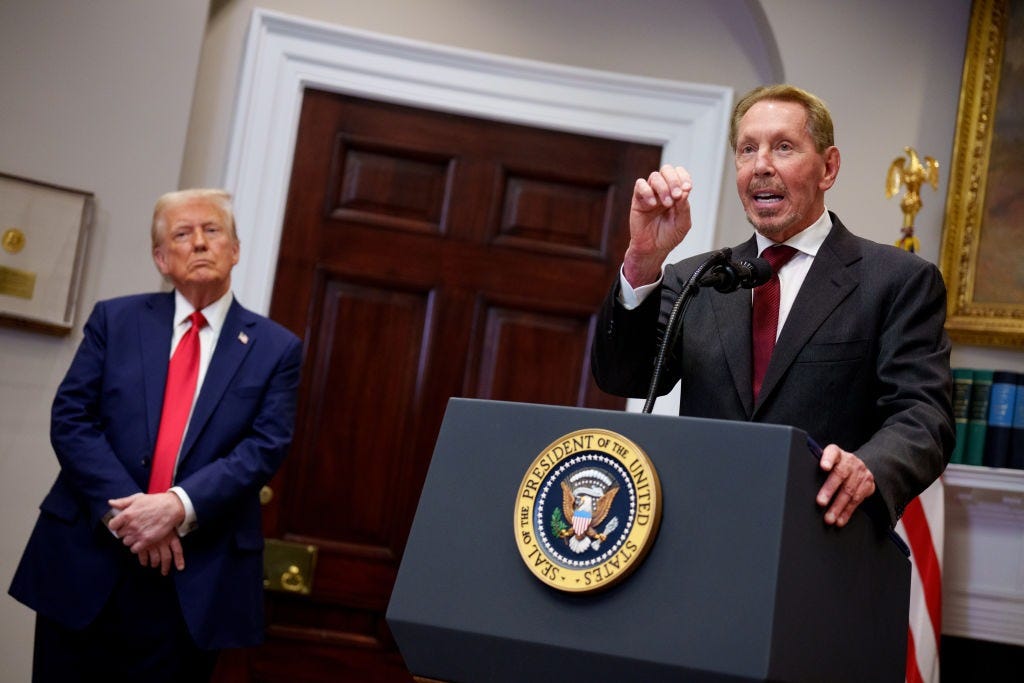
This isn’t just speculation either. We can see how it is playing out with TikTok. The Council on American-Islamic Relations, the nation’s largest Muslim civil rights organization, has condemned TikTok’s recent “censorship spree” against content critical of Israel. They noted Ellison’s history as a major donor to the Israeli military and his close personal relationship with Benjamin Netanyahu.
We’ve seen this playbook before. Bezos with the Washington Post. Zuckerberg with Instagram. Musk with X. Weiss with CBS. Technically these companies aren’t run by one person, but they’re controlled by Wall Street and the corporate class. This merger is about power, and workers are nowhere in the conversation.
JR: We aren’t hearing about the impact on the workers who produce this media. What has been the historic impact of corporate consolidation of media on entertainment workers? What do you think this merger could mean today?
RS: It’s been brutal, especially for freelancers. Hollywood isn’t a factory. Everything is project-based. When an eight-month film or TV series ends, that’s it. There’s no fallback job, no place to transfer. And when work dries up, most of us don’t get laid off, our jobs just disappear.
Shows don’t get picked up. Seasons get shorter. Departments get smaller. Most people are hired through relationships built over years, and crews tend to move together from job to job. But when the people who normally hire you aren’t working either, there’s nowhere to go. Suddenly there are thousands of people competing for the same few gigs. Your options become taking whatever you can get, leaving the industry, or leaving Los Angeles altogether because you can’t afford to wait it out.
The financial strain has been devastating. Many workers have been forced to change careers just to avoid going into debt. And the emotional toll is just as real. People build their entire adult lives around this work, often moving across the country to be part of it. Being pushed out isn’t just losing a job, it’s losing your identity.
In the last three years alone, the industry lost roughly 41,000 film and TV jobs. Around 16,000 IATSE members reportedly lost their health insurance because they couldn’t bank enough hours. There’s often no clean paper trail because work disappears quietly, but there’s no question consolidation has played a major role.
You can see the writing on the wall by looking at studio staff. When Skydance merged with Paramount in 2024, about 10% of staff were laid off overnight. When Disney bought Fox in 2019, roughly 4,000 workers lost their jobs. Netflix was signaling it expected at least $2 billion in “cost savings” if it acquired WBD. Everyone in this industry knows what that means: thousands more layoffs. And with even more IP concentrated under one roof, production itself could slow dramatically. That’s the reality facing the people who built this industry.
JR: Paramount’s presumed acquisition of WBD also represents some of the bigger economic trends in the entertainment industry that have been causing bigger changes in Hollywood for a while now. How are we seeing some of these changes come to a crisis moment in recent years?
RS: It’s all coming to a head. Streaming, AI, and runaway production aren’t separate problems, they’re interconnected and hitting workers all at once.
You hear it most clearly from people who’ve been around a long time. I recently heard from a veteran dolly grip who was on a high-end commercial and noticed something missing: no blue screens. Normally, that setup would require extra crew and days of work. When he asked why, the visual effects supervisor told him they’d just do it with AI. It’s a small example, but it says everything. Work that once supported entire crews is disappearing quietly, shot by shot.
At the same time, writers’ rooms are shrinking, actors are being scanned so studios can reuse their likeness indefinitely, and productions are shipped overseas to dodge union contracts. All of this is about cutting labor costs and breaking hard-won protections.
That’s why 2023 exploded. The strikes weren’t just about pay, they were about survival. Mergers like this pour gasoline on the fire. More consolidation means more power to automate, offshore, and squeeze workers even harder. No matter who wins this bidding war or the next one, Hollywood workers are the ones who will pay the price unless something fundamentally changes.
JR: What do you think ultimately needs to be done for workers to respond to megamergers like this and to generally deal with the corporate power of media giants that this represents?
RS: First, we can’t treat these mergers as abstract business deals anymore. They are labor issues, plain and simple. Consolidation is designed to create a corporate bloodbath, and workers always pay the price. We can’t wait for the government to step in and save us. The only real answer is building the power and solidarity to fight back.
Every contract cycle, studios claim there’s no money for fair wages, residuals, or humane working conditions. But then you see bids like $80 or $100 billion on the table. The money is there, it’s just not meant for workers.
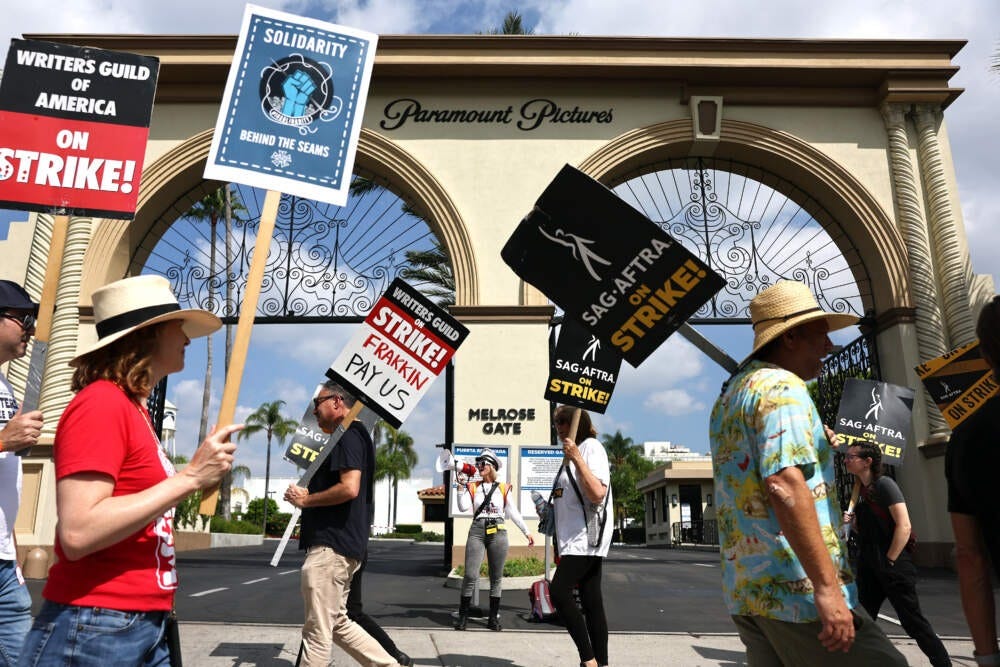
That’s why the WGA’s early opposition to the merger was so important. They’ve consistently seen the horizon first, whether it was the 2007 strike over streaming or the 2023 strike over AI. With WGA and SAG-AFTRA contracts expiring in early 2026, the next round of negotiations won’t just be about bread-and-butter issues. It will be about the future of this industry and the people who make it run.
We also need to think bigger. As attacks on working people escalate across industries, there’s growing talk of mass action and even a general strike. That is the type of response to the billionaire agenda that we need. If we want to challenge that power, we have to scale up our own. It’s happened before. It can happen again.