


Healthcare workers organize as hospital labor unrest keeps spreading
Healthcare workers are continuing to organize across the country as hospitals and health systems face another year of strikes, contract fights, and union elections driven by staffing, wages, burnout, and the rising cost of care.
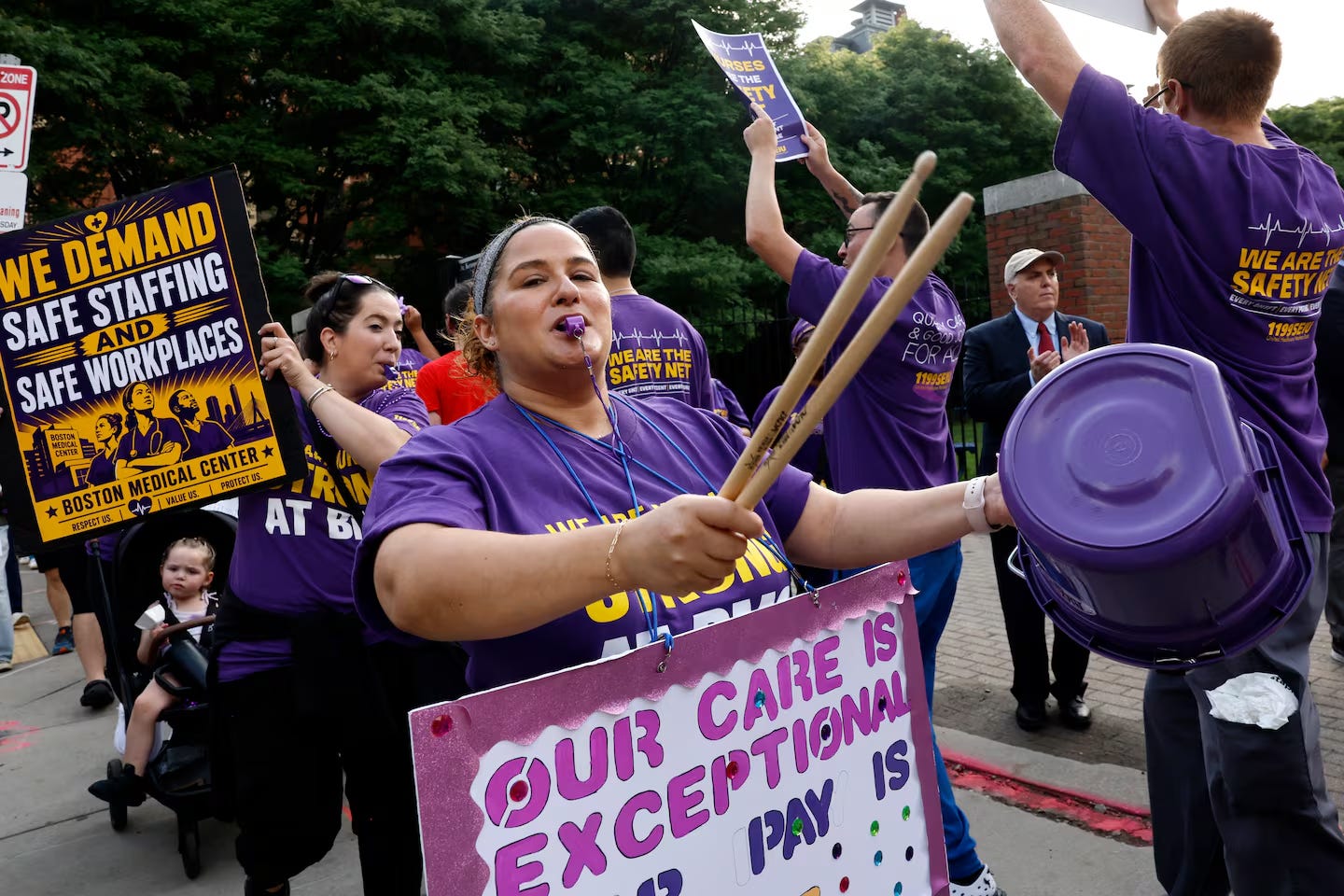
In Boston, a multi-union coalition at Boston Medical Center is continuing its fight for fair contracts covering thousands of nurses, physicians, residents, fellows, and healthcare workers. Members of 1199SEIU, the Massachusetts Nurses Association, and CIR/SEIU have united as the BMC Unions Coalition, pushing for fair wages and the staffing investments needed to protect patient care.
The coalition has recently held informational pickets as negotiations continue. BMC is a level one trauma center and home to one of the busiest emergency rooms in New England, serving one of the most diverse patient populations in Boston as a safety net hospital. Workers say that reality should make investment in frontline staff a priority, not an afterthought.
The BMC fight comes on the heels of the Brigham and Women’s strike and Mass General Brigham Home Care strike, the largest nurse and healthcare professional strike in Massachusetts history. More than 4,000 Brigham nurses and 450 MGB Home Care clinicians struck over wages, staffing, caseloads, and patient care. BMC workers are now carrying that fight into another major Boston institution.
Meanwhile, in Missoula, Montana, more than 680 service and technical workers at Providence St. Patrick Hospital voted overwhelmingly to join SEIU Healthcare 1199NW. The vote was 446 to 102, bringing certified nursing assistants, environmental services staff, EMTs, radiology technologists, surgical technicians, pharmacy technicians, and other workers into the union. Providence is a massive multistate health system based in Washington state, and workers in Montana are now joining a broader wave of healthcare employees demanding a real voice on the job.
These fights are part of a much larger trend. Becker’s Hospital Review has tracked 17 healthcare strikes so far in 2026, continuing the elevated strike activity seen in 2025 and far above the pre-pandemic average of just a few major healthcare strikes per year. The strike wave reflects a healthcare system where executives continue to push staffing shortages, rising healthcare costs, and corporate technology schemes onto workers and patients alike.
Hospitals keep telling workers there is no money for safe staffing, wages, or respect. But healthcare workers know the truth from inside the system: hospitals do not run without nurses, techs, physicians, environmental service workers, home care clinicians, and support staff. They are organizing because the system is buckling, and because the people closest to patients are tired of being told to absorb the crisis quietly.
Airline workers organize amid another year of aviation instability
Airline and airport workers are also continuing to organize, winning contracts and union recognition in an industry still marked by staffing shortages, public infrastructure failures, increasingly normalized shutdown chaos, and privatization threats.
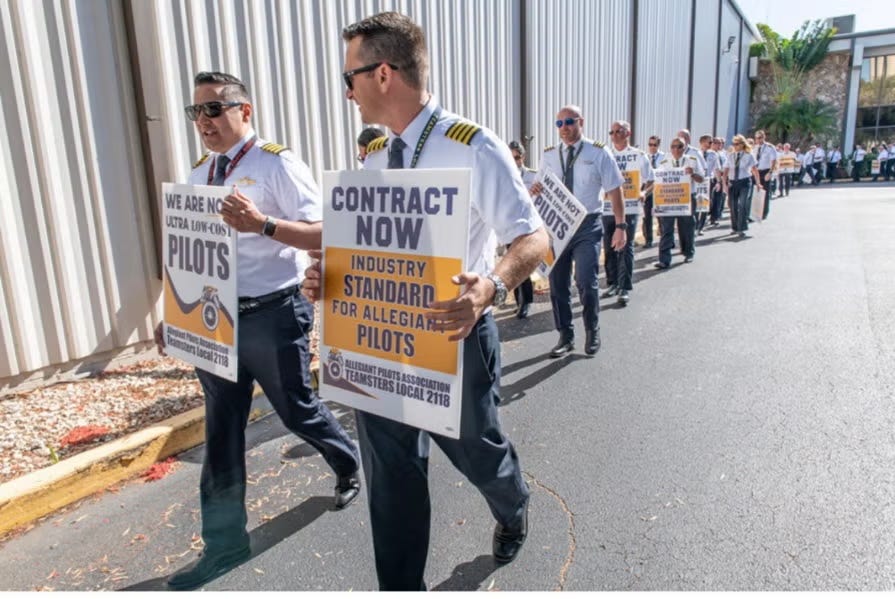
Nearly 1,300 Allegiant Air pilots represented by the Teamsters ratified a new two-year agreement this week after years of contentious negotiations. The pilots had been working under a contract ratified in 2016, demanding industry-standard pay and improved scheduling.
The new agreement delivers an immediate average hourly wage increase of about 40%, with wage increases reaching about 54% by January 2027, along with improvements to retirement benefits, work rules, and quality of life. The Teamsters also said ratification triggers roughly $300 million in accrued retention bonuses for pilots. Allegiant pilots had been fighting for years to bring their pay and conditions closer to industry standards.
Fuelers at Orlando International Airport (MCO) employed by Menzies Aviation moved to organize with the Transport Workers Union, expanding TWU’s footprint at one of the busiest airports in the country. MCO is already a major TWU stronghold, with the union representing large numbers of airline workers across the airport. A fueler organizing win adds another essential group of workers to that base.
Fuelers are often invisible to passengers, but they are critical to keeping flights moving. They operate fuel trucks, connect hoses, oversee refueling operations, and help ensure planes can turn around safely and on time. Their work sits at the center of the airport operation, but like many airport service workers, they have faced low pay, high turnover, and difficult conditions under subcontractors that serve the major airlines.
The broader airline system has been in crisis for much of the year. This spring’s government shutdown forced tens of thousands of TSA workers to go without pay for weeks, contributing to major airport disruptions and security waits that stretched four hours or more in some places. Now the Trump administration is pushing privatization experiments in airport screening, while TSA workers and AFGE warn that contractors will cut staffing.
Meanwhile, the FAA continues to grapple with long-running air traffic controller shortages and aging infrastructure. The agency has released a workforce plan to address staffing gaps, but the system remains fragile. A regional FAA equipment outage this week caused hours-long delays across the Midwest, including at Minneapolis-St. Paul, reminding travelers that airline chaos is not only about weather or bad luck. It is about decades of underinvestment in the public systems that make air travel possible.
The airline bosses want passengers to blame workers when flights are delayed, lines are long, or systems break down. But workers did not create this crisis. Chronic understaffing, outsourcing, shutdown politics, privatization schemes, and underfunded infrastructure did. Now workers across the industry are organizing to make clear that a safe, reliable aviation system requires good union jobs at every point in the operation and investment in the system, not a barebones operation to extract maximum profit.
BONUS ROUND
Bring it to the shop!
The Pickets & Power Bulletin covers the biggest stories impacting all working people today. Share these stories with your union siblings, coworkers, friends, and family. Read it together, discuss, and take lessons to strengthen your own fights. When we fight, we win – and when we fight, we learn. Tell us in the comments about campaigns you think we should include in our next bulletin!